Sunday, March 14, 2010

LUCKY MAN, LUCKY CHEF

I can't believe how lucky I am.

I know a lot of people say that and then the drift of what they are saying, despite it's good intentions, comes off as maudlin, treacly, or downright sappy. Good luck and good fortune comes to those who make it, but it certainly helps to have some back-up in your corner to give you the support you need. This I know.

I am lucky to work, cook and create in an environment that allows me as much freedom as I could ever possibly want. Yes, I work in one of the most beautiful places in the world and it's true that my kitchen looks out over what is easily in the Top Five of all views from any restaurant kitchen anywhere. It is also true that I search out, and have brought to me, impeccably beautiful produce, grown locally and organically. The fish and poultry I use in my recipes is locally caught and grown and it's pedigree of freshness is unparalleled. These things contribute to my amazing good fortune.

But what makes the entire equation come together is the support and freedom I get, to do what I do. My boss is my biggest fan and one of my best friends and it is so rare that he has ever told me how or what or when to cook. I've never been great with authority, and I'm sure, NO, I know that much of the stress and many of the problems in previous restaurant incarnations were derived from my clashing with the powers that were. Now I wake up in the morning and there is no knot in the pit of my stomach caused by whatever run-ins I may have upon arriving at work. Rather, I wake up and think about the farm fresh food that will arrive that day and how it will combine with the beautiful things already in my refrigerators. This is a gift and I am so grateful for it.

This past Saturday night I had a small group for dinner and wanted to try out a few new things based on some new ingredients and also on a budding idea or two that I had been mulling over in my mind's palate.

As I do every day, I began by making my dessert for the evening. I had made an extremely rich and flavorful batch of caramelized banana ice cream two days before and wanted to use it for dessert last night. I had discovered the key to the ice cream is to roast the bananas with butter and a mix of dark sugars until they get rich and sticky in the oven, puree them, and build the ice cream on top of that flavor.

There are, I presume, still pastry chefs and restaurants who serve a dessert called, 'Death by Chocolate". I wanted to serve "Life With Bananas", so decided on a caramelized banana tart to pair with the ice cream. I made a batch of caramel, poured it in a pyrex pie dish and laid sliced bananas over the top in a nice pattern. The cake base is simple; banana creamed with butter and more dark sugar, eggs, sour cream and flour. This all goes over the caramelized bananas and gets baked, then turned out, a la an upside down cake. It is simple, but rich and quite delicious. Dessert was in the oven and to my mind, done.

I always start my guests out with a small taste of a chilled soup; a pure expression of flavor that will cool and clear their palates, readying them for the bursts of flavor still to come, but wanted to move beyond where I had been. I had been making a carrot-ginger puree, sort of a traditional combination of flavors and was happy but not fully satisfied with it as a starter. My first addition to it was a spoon of a yellow Thai curry paste to the initial sauteeing of the onions, carrots and ginger as the soup was starting. And I wanted a hint more sweetness, so I began pureeing the soup with orange juice after pouring off a bit of the cooking liquid. This I liked. This was a good direction.

But I also wanted a greater depth of flavor and felt the need to do something about the color.
Beets were the perfect flavor and color to augment the base sweetness of the carrot and I keep gallon jars of roasted beets packed in balsamic vinegar in my refrigerator for salads, so this step was easy. I plopped the equivilent of about four beets into my cooking carrot-ginger liquid and pureed all of it together. The color was a brilliant not-quite-blood red; I loved it.

And today, I had forgotten to bring in oranges for the juice and the pureeing process so I searched the kitchen for something that would work in its stead, something exotic. We make a "frescito", a cool fruit drink for our guests at the Lodge each day and today it happened to be made from maracuya, passion fruit. Perfect. As I ladled the cooked carrot-beet mixture into the juicer, I added hefty glasses of the lightly sweetened passionfruit juice to the mix and let the blender fly. What emerged was a beautiful deep ruby color. It was alive with the scent of ginger and what I can only describe as a floral essence. I stuck my finger into the still hot mix and took a taste. Wow. The maracuya was IT. I chilled a pitcher for service and froze the rest in ziplocs for future diners. Great start.

Next step was the salad. I had garden fresh organic lettuces already cleaned, courtesy of the day crew, but wanted to add a few touches to it that would take it out of the realm of "green salad". I've been getting organic cherry tomatoes, small and brightly flavored, from Marjorie and Bolivar at Diamante Organico, down in the San Salvador valley; and they add a great touch. Angelica and I split these and dressed them with sea salt, fresh cracked pepper, a splash of sherry vinegar to bring up the acid and a drizzle of olive oil. We'd let these sit for a few hours before service so that the dressing would "take".

I have been using a lot of palmito, or hearts of palm, lately and had several lengths still in the refrigerator. It grows right here on our property. But I also had some small kohlrabi, the oddball of the tuber/root family, also from Diamante, that I wanted to do something with. The idea hit me that if I cut both the kohlrabi and the palmito into discs, they would be the same size and almost the same color. The palmito wouldn't need cooking, it has a nice fresh crunch on its own, but to achieve the same texture for the kohlrabi, I'd need to blanch it. I liked the idea of the two white discs, side by side in the salad, looking the same, but tasting quite different.

I wanted some bite and a little color, so I sliced the white part of large green onions into thin white discs as well and now had three sets of white circular vegetables. Color; it needed color, so I fine sliced sweet red bell pepper (chile dulce, here) into thin, thin strips and then cut those into thirds, almost splinter like. I tossed all this with sea salt and pepper while contemplating my dressing. I generally do my palmito salad in fresh mandarina juice (like an orange lime) and olive oil, but I felt like the kohlrabi wanted something a bit more substantial and I decided on an herby-citrusy mayonnaise as the dressing.

I chopped Italian parsley coarsely, along with a handful of garlic chives and put them in the Cuisinart along with a whole egg and a yolk to base the mayo on. I added the juice of four mandarinas, a dash of chilero (a habanero-vinegar table sauce we make), S&P, and set the machine to whirling. I like the green color and knew it would make a lovely pale colored dressing. With the machine on, I slowly added a blend of half olive oil and half corn oil to build the sauce, and could feel it thicken in the machine as the sauce crept of the side of the mixing bowl. I added a bit of warm water to keep it from getting too thick, I checked for acid and salt, and added a bit more mandarina and another shake of sea salt. Both the kohlrabi and the palmito were very mild, and the hit of salt and acid would bring up their flavors.

I stopped the machine and scooped out the mayonnaise. I like the pale green color and the balance of flavors were going to work great with the salad. I put a couple of spoons of the dressing into the kohlrabi-palmito mix and worked it in with my hands. I plunged a teaspoon in for a quick taste and loved it. The crunch was there, a bit of sweetness from the red pepper was evident, and the mayo lifted it and brightened it just enough. It would make an excellent third party to the softness of the organic lettuces and the vinegary tartness of the cherry tomatoes. Two courses down and onto the chickens.

I've been buying nice big organic chickens from Mauren and Ademar, a Tico couple who also grow vegetables for me, and they are a great product. I made a trip up to the farm before I began buying them, as I wanted to see what the birds eat, and was quite satisfied to see them snacking on the trimmings from the lettuces and greens, along with their corn. I buy four chickens once a week and break them down into legs for braising and breasts for roasting. Angelica and I treat ourselves to the wings and I freeze the livers for pate.

Tonight I would roast the breasts and as I did my old-school butchering I pondered my sauce and side options. I wanted to use risotto as a starch base, but was pondering the best way to lift it out of its Italian heritage, while not obscuring it's creamy goodness. I knew that I was going in a mango/citrus/ginger flavor with the chicken sauce so I wanted the flavor beneath it to compliment and augment it nicely. Ideas, I had ideas. I finished the chickens wrapped the legs and chose four fat breasts for roasting. I would get nearly two orders out of one breast they were so plump.

I started work on the chicken sauce while still pondering the risotto question. I pureed four mangoes and put them in a stainless sauce pot along with a cup of mandarina juice, a fist full of grated ginger, a splash of the habanero based "chilero" and a cup of tapa dulce, our local cane sugar. I let this simmer while I worked on the risotto. I had decided on a ginger-curry flavor for it, so with the diced onion I always start risotto with, I added a tablespoon of grated ginger, some diced red bell pepper and a small spoon of yellow Thai curry paste. I had put on a pot of a light chicken stock to boil and when it came up to heat, I stirred the risotto into the cooked onion-ginger mix and made sure to coat the grains of rice with the cooking oil. I added a ladle of the boiling stock and stirred well. I added and stirred, added and stirred until the risotto was still slightly crunchy. I threw in a small handful of diced green onions, removed the rice from the heat and spread it evenly over a sheet pan to cool.

The cooking mango mixture had reached a syrupy point and was quite aromatic. I took it off the heat and pushed it through a fine mesh wire sieve. This would be the flavor base of my sauce and would also make a great glaze for roasted fish or chicken at another meal. This was my "Salsa de la Jungla".

To make the sauce I'd serve with the chicken that night I peeled and diced another two mangos (can you tell it's mango season?) and put them in the blender along with another cup of mandarina juice. I blended these together and added a stiff spoonful of the my cooked mango mix, a generous pour of canned coconut milk, another splash of "chilero" and a handful of chopped cilantro. I stopped the machine and tasted. Hmm, I liked it. Nice heat, good ginger flavor; sweet and spicy, just what I was looking for. I would mix this into the intensified chicken stock that would come out of the oven with the roasted chicken breasts, to heat it up and finish the sauce. I browned the chicken breasts on the skin side, ladled in the stock and put them in the oven to finish cooking.

Angelica had cleaned the mix of organic braising greens; seven or eight kinds, again from Diamante Oraganico, and had also blanched of several lengths of Chinese long beans. I would steam these with garlic and ginger to complete the flavor profile of the entree plate. I want the flavors of my vegetables to stand out on their own, but also be complimentary flavors to the plate as a whole. The chicken, sauce, risotto and vegetables all should play an equal part in making the plate a success.

Our small group trooped in and the soups went out along with pitchers of the passion fruit frescito. The bowls of soup came back empty almost immediately. I had the chicken breasts in the oven with a bit of stock, to heat them so we began to plate the salads. The lettuces we dressed lightly in a bit of a balsamic emulsion, we piled the cherry tomatoes left and right, and presented the kohlrabi-palmito salad in front, as the centerpiece. The salad looked great, and one taste of the kohlrabi-palmito mix told me it was a winner.

Immediately after serving the salads I set up a slicing station for the chicken breasts. I would slice and present the chicken over the risotto, as the breasts were far too big for one serving.
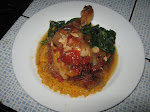
I heated the gingered risotto in a little chicken stock, took a taste, and placed a mound at the front of the plate. I draped the greens over the back half of it and Angelica put several knotted long beans behind it. I sliced the chicken breast in medallions and placed them half over the risotto and half over the greens. A ladle of the brilliant yellow mango sauce went over the top along with a sprinkling of snipped garlic chives. Stunning and nicely aromatic. I was happy with everything on this plate.

Dinner was a lingering affair; the night was warm, the lights on the ocean sparkling and our guests called me over to ask about the meal and offer compliments. Geinier, my boss, had powered through his and offered his own style of compliment as well. I waited patiently until the plates came back and then plated up a wedge of the dripping caramely banana tart. Over the tart I spooned a dollop of the rich ice cream and out they went. We turned to the kitchen and it was nearly already clean. I put away and wrapped a few dishes, plated food for my staff and smiled that smile. I knew it was a good; no, perhaps a great meal. I am a lucky man and a grateful Chef.

Friday, March 12, 2010

YOU GET WHAT YOU NEED

This is my latest submission for the April edition of Dominical Days.

YOU GET WHAT YOU NEED

Hallelujah!! It is now possible to buy organic produce and fresh fish in Uvita four days a week and under one roof. GLAGLEMAR has opened in the Uvita Rincon.

While the rest of the civilized world has been able to purchase organic produce for several years, it has taken far too long for it to reach the Zona Sur. We have suffered the indignity of having to buy produce trucked in and looking and tasting the worse because of it. Yes, we have a once a week Feria, but that certainly doesn’t address our daily needs.

At last we can get produce straight from the farm. Finca Los Coriotos to be exact. Ademar Valera and Mauren Jimenez are harvesting their fields and bringing their crops to Uvita Monday-Wednesday and also to the Saturday Feria. No more picking through a selection of vegetables of limited and dubious quality. Carrots are carrots and onions are onions, but when I want a great salad, or fresh green vegetables for my dinner, I shudder to look in the local markets.

And joining Ademar and Mauren under the GLAGLEMAR roof is fish from Pescado Jomar.. Previously, our options have been to either truck down a dirt road and deal with a buying a whole fish or to go to our markets and look at the sad watery filets either formerly frozen or sitting forlornly in a watery bath of melting ice.

Alongside the gorgeous organic produce we can now also buy fresh tuna, pargo, dorado and shrimp straight from the Pacific in one kilo packages. This is the same operation who have been doing a great business on Fridays at the entrance to Ojochal. Now they’re in Uvita.

Please help us all by supporting these courageous folks. You can’t always get what you want, but sometimes, You Get What You Need.


A PERFECT PAIRING

What I really like for dinner on a hot night is a great piece of fish on a fresh green salad; simply cooked and nicely dressed. When it gets as hot as it has been here this summer, this makes an excellent solution to keeping it simple. This is so easy, you can make it at home and never heat up the kitchen.

Cut a couple of nice pieces of pargo or tuna off a filet, season them with salt and pepper and let them rest while you fire up the grill and then prepare a great salad. Cut a tomato into wedges and lightly salt it, slice a red bell pepper into rings, slice a few radishes (I like radishes) as thin as you can, and of course peel and slice a ripe avocado. Put a mix of fresh organic lettuces in your salad bowl. They get washed by the farmers so, don’t worry about dirt or grit. The wetter young organic greens get, the quicker they wilt, so keep them dry. Put everything in the fridge while you make this simple summer dressing.

CHEF DAVE’S SIMPLE SUMMER DRESSING

1 Tsp (5 mL) Dijon Mustard

1 clove chopped garlic

2 Tsp (5 mL) Mandarina juice

2 Tsp (5 mL) Red Wine Vinegar

½ (120 mL) Cup Olive Oil (use a good one)

salt and pepper (to taste)

Whisk the Dijon, garlic, mandarina, vinegar, salt and pepper in a bowl until well combined. While still whisking vigorously, add the olive oil in a slow but steady stream.

Put the fish on the grill and when it is just about ready, toss the lettuces and vegetables with a couple of teaspoons of the dressing.

Plate the salad and place the tomato and avocado on top.

Nestle the grilled fish up next to your salad and sprinkle a bit of dressing on top.

Sit outside on the patio, pour yourself something cold, and enjoy.

Monday, March 8, 2010

THE PLATE, THE WHOLE PLATE

THE PLATE, THE WHOLE PLATE

I have been fortunate enough to have been able to enjoy dinner at what are considered to be two of the best, if not the best, restaurants in the Uvita-Ojochal area. Both are "jungle elegant", nicely appointed and touched with a European influence. The service at each leans toward formal, and if it doesn't quite accomplish serving the guest well, at least the intention is there. Each of these restaurants enjoys a great reputation, gets plenty of coverage in our local press and promotes themselves colorfully and expansively.

And while the food I had at one was markedly better than at the other, I was struck by something that I've been considering for a while, and attempting to overcome in my own kitchen. On each of my entree plates, the protein product was clearly the "star of the show", but the rest of the cast of characters, the starch and the vegetables, seemed lackluster, added as if they "had" to be there. And in fact, the vegetable accompaniments at each restaurant were exactly the same; a nicely arranged, but lukewarm (and unseasoned) combination of haricot vert, carrot, cauliflower and broccoli.

Additionally, at each of the restaurants, the starch accompaniments were a bland unseasoned white rice, mashed potatoes, or sauteed potatoes. There was no thought given to whether or not these starches represented an appropriate (God forbid they should be challenging or interesting) compliment to the protein product. Our choices of rice or potato were there simply because they "had" to be there. It would be unthinkable to put our an entree plate without rice or potatoes.

I had a Swiss couple in for dinner the other night and at the end of their meal they stopped by the kitchen to thank me and the woman made a comment that I appreciated and took as a form of confirmation. She told me that she enjoyed that my plates were "balanced". I asked her what she meant and she remarked that it was clear to her that each of the items on her plate carried equal importance in the construction of the dish. I had served her fresh shrimp sauteed with a roasted tomato sauce on risotto; a mix of braised organic greens, sauteed Chinese long beans with garlic, and steamed cauliflower florets.

This attention to the full plate is what I am striving for and what I wish I could see more of in other restaurants that I visit. We live in an area rich with a wide variety of fruits and vegetables; too rich to allow us to limit ourselves to "safety cooking". This concept of letting the protein product and its sauce be the "main attraction" is an old school notion and addresses neither an awareness of the way people are eating, or an awareness of the way cuisine is shifting.

I believe it is incumbent upon those of us who have chosen to be Chefs to take responsibility for many aspects of our guest's experience in our dining rooms. Comfort, yes; escape, yes; satisfaction, naturally. But moreover, we have responsibility to help our diners to explore new regions and new sensations. We have a responsibility to the health of our diners, physically and spiritually. Certainly, the guest wants and needs a "comfort zone" experience from time to time and he should know where to go to get it.

At La Cusinga, however, I will continue to buy the best, freshest and sometimes the oddball ingredient from my farmers. I will continue to place an equal value on everything I place on my plates. And I will continue to encourage my guests to open their palates, open their eyes and, most importantly, their minds. Dining out should be a fresh, bright experience, not sadly predictable.

Friday, February 12, 2010

DOG BITES MAN

DOG BITES MAN

DOG BITES MAN

It had started out as a simple healthful Sunday morning walk. Up through the Bamboo Family’s property, up and across the creek and up, up, up. Well frankly, I hadn’t known there was going to be so much up involved, but there was, so I went. I was with Linda and Jackie and they’re both pretty good walkers, and I figured I’d better hold my own so I did. We were doing some pretty good sweating because every turn seemed to turn into another turn and they all were going up.

When we finally got to the Camino de Suenos sign I was ready for a breather and Jackie informed us that the worst was over and we were almost there. We headed down that road, which was nice and shady and crossed into Lillian’s property. Since that was where we were going, we eased up our pace a bit and wandered past a house that we’re interested in and up the drive past a couple of others. The view was spectacular and the ocean was blue and there were horse pastures and corrals and stalls; all the trappings of a real ranch. Jackie said, “Let’s stop in and see Lillian and tell her we’re here.”

We climbed up a bit farther, since it is all about getting to the “view” when you live in the coastal mountains here, and got to the front of Lillian’s house. There was a big wrought iron gate, a big dog on a chain, and there was Lillian, waving and calling out to us from upstairs in her house. She trotted downstairs, unchained the big dog and wandered away, talking over her shoulder like she does. Her parting words were, "Get acquainted with the dog." The dog wandered over and we set about getting acquainted.

He sure was a big guy, coming up nearly to my hip with a head bigger across than my splayed hand. Jackie informed us that he had just returned from a week long visit to the vet after a tangle with some of the local wildlife. I commiserated and stroked the top of his huge head. He was good, I was good, so I stroked his head some more and told him what a good guy he was. I rubbed his giant floppy ears and he seemed to like that too, so I chucked him under the chin a bit. Lillian called something to us, from up in the house again, the dog and I both turned and then he whirled around and slashed at my right hand and ambled off.

It happened like lightning and in disbelief I looked at Linda and said, “I think he bit me.”I looked at my hand and there seemed to be a long white crease running from the base of my right thumb to near my wrist. It was oh, so white, and then it was very, very red. The blood seeped up and out of it with my pulse and was thick and bright. I think Linda said, ‘Oh My God” and then Jackie said, “Did he bite you?”

I told myself to breath while everyone seemed to run around me. Jackie ran to I don’t know where and returned with gauze. She slapped it on my hand and we watched it soak through. Lillian appeared in a panic and ran in several circles trying to do too many things at once. Linda stood at my side and held my hand, saying, “Are you all right?” Lillian reappeared with a tube of something golden brown and much, much more gauze.We all agreed that the clinic must be called and trooped upstairs to Lillian’s deck.

She scrabbled for phone numbers and scrabbled for Tylenol, returning with three that I already knew weren’t going to do much good. She and Jackie couldn’t decide where the number for the clinic would be so I reminded them that it might be in one of the local magazines, published for locals and tourists alike. Everyone kept asking me if I was okay, but all things considered, I was fine. It was a dogbite, not that dissimilar to a nasty restaurant cut and nothing would be gained by freaking out. “Breathe”, I told myself again.

The calls were made to Dr. Mauricio, who runs our local clinic; pulling him away from his family on this Sunday and within minutes we were tumbling down the hill in Lillian’s 4X4. And we talked about all kinds of odd and unrelated things as we bumped and clunked down the hill. Linda and Jackie were in the back where there were no seats so they bounced around more than we did in the front seat. We got to the clinic and Dr. Mauricio was not to be seen.

I didn’t want to sit in the car anymore so I got out and Lillian hightailed it for a payphone since none of us had had the foresight to bring a cell. I suppose we hadn’t felt I was going to get bitten by a dog that day. Anyway, just as soon as Lillian took off across the highway, the doctor arrived and we were treated to some unintentional humor as he talked to her on his cell while she was 200 yards away on the payphone, yelling and asking him where he was. He and I walked into the back part of the office and the fun began.

Dr. Mauricio is a great guy, young and very calm and patient. He has treated me for a Papalamollo infection, wasp stings and now this, the dog bite. He put my hand over a tray, glopped on more gauze and went about gathering his things. We both kept wiping the blood away, which was, if I haven’t mentioned before, plentiful. Then he got the anesthetic needle out and filled it up. I could hear the three women in the waiting room telling stories of their own cuts and wounds. I always think its funny that things like this bring out the history of others. Cooks do this with knife cut stories.

A Costa Rican doctors office is pretty Spartan. There’s a table for the patient, a couple of medicine cabinets and not much more. And oh yeah, no nurses, which is how I ended up holding two suture clamps keeping my wound closed while Dr. Mauricio did a crude stitching in my palm using something that looked way too much like a fishhook without the barb. If this had been the US, I would never have seen my hand, would never have watched with a detached curiosity as the doctor probed me over and over again with the anesthetic needle until I was nearly numb and would never, ever have participated in my own procedure. And as I said, if I had been in the US, I would never have seen my hand; it would have been slung out to my right, over a tray with two or three people attending to it. But this is Costa Rica.

Dr. Mauricio and I both breathed heavy sighs of relief as he finished tying off the final knot. Him, I suppose because it wasn’t really how he had planned to spend his Sunday morning and me, because in all the exploratory applying of the anesthetic, a lot of areas had gone un-numbed and the entire process had been a bit more painful than I was initially prepared for. There was still a lot of blood lying around and he cleaned and wiped while I stood up and admired the six somewhat widely spaced crude stitches. Again, in the US, this would probably have been between 12 and 15 nicely arranged stitches, but here it was six and that’s just the way it was. The doctor wrapped me up awkwardly (how does one tape around a thumb?) and off I went into the waiting room where the three women were.

Lillian dropped Linda and me off at home while she drove up the hill to plunder her cabinets for medical supplies. I gulped a handful of Tylenol and Linda and I got ready to drive up to La Cusinga to tell them I wouldn’t be working that night, or, it seemed, for the next several. Another Costa Rican adventure and a rare Sunday at home, but a tough way to get it.

Thursday, February 11, 2010

TOMATOES; ALL YEAR. WHO KNEW?

This piece was written for the March edition of Dominical Days.

TOMATOES; ALL YEAR. WHO KNEW?

Tomatoes! Ripe tomatoes everyday!

Yes, good quality ripe tomatoes are available year round here right near us and they’re cheap, cheap, cheap. You don’t have to settle for those rock hard, chalky, pale imitations being sold at our local mercados. If you are like me and unwilling to accept (or just not include in your menu) mediocre tomatoes until the “season” arrives, this is heaven.

Any regular visitor to the Feria in San Isidro can find “Tomato Nirvana”, seemingly year round. There are a number of vendors taking advantage of the amazing growing climate here to keep rotating crops in order to keep luscious flavorful ripe tomatoes on their stands weekly.

There are numerous stalls around the Feria that sell tomatoes at wonderful prices, but the one I frequent has mountains of tomatoes separated by size and price. It is run by one family and while Madre takes the cash, Papa and the sons keep piling more and more tomatoes onto their red mountain.

The cheapest tomatoes are the smallest and least cosmetically perfect. For these I pay the princely sum of 350 colones/kilo*, and roast for sauces and soups. The middle size is a perfectly decent tomato, great for sandwiches, salads and dozens more uses. The price for these skies up to 450 colones/kilo*. And finally, the largest of the three, great for featuring sliced as a salad command an outrageous (!) 500 colones/kilo*.

Yes, it’s true you will have to pick through the tomatoes to find the ones you like, but this allows you to vary ripenesses and plan your week of tomatoes. At La Cusinga I ripen them on shelves and have them arranged so that I always serve the ripest first. I NEVER REFRIGERATE TOMATOES. EVER. I look forward each Thursday to shouldering into the crowd, grabbing my three or four bags and pawing through the perfect and imperfect beauties so I can have ripe tomatoes every day of the week.

*For those of you reading this in the US, these prices translate at from $.32 to about$.48 per pound

Roasting and Roasted Tomatoes

A perfectly ripe tomato is one of nature’s treasures and shouldn’t be altered (except perhaps with a little sea salt, some fresh cracked pepper and a droplet of olive oil), an even better way to intensify tomato flavor is by oven roasting them. I first started oven roasting tomatoes in the US in an effort to coax flavor out of cottony, out of season imposters.

It seemed to me that if I was able to wring flavor out of nasty juiceless specimens, just think what would happen if I roasted ripe tomatoes. I did, they were great and they have become a fixture in my kitchen. No more long cooking tomatoes for sauce, and better yet, no more canned tomatoes. I make rich-flavored tomato sauces and soups with inexpensive fresh roasted tomatoes. And you can freeze these in ziplocs and thaw with no loss of flavor. Dollop them on fish, add them to pan-roasted chicken; add capers, basil or citrus zest. You’ve got the basics, now have fun.

Here’s how:

Heat oven to 450;

Pour enough olive oil on a cookie sheet to coat it, thickly;

Core 20 small ripe tomatoes and cut in half;

Lay the tomatoes cut side down on the oiled sheet;

Slice 2 large yellow onions into ½” (1.27 cms); break into rings;

Arrange the rings around and over the tomato halves;

Sprinkle 12-15 whole peeled garlic cloves over all, and;

Pour another good drizzle of olive oil over the top.

Salt and pepper liberally.

Roast the tomatoes about 35-40 minutes until the tops start to turn brown.

Remove from oven and let cool.

For an amazing tomato soup, hot or cold, puree the tomatoes and all the juice in a blender.

For a great no stovetop tomato sauce hand chop the room-temp tomatoes, mix in a little basil and hand toss with pasta. So good.

Tuesday, February 2, 2010

KATIA KILLS THE CLEARWRAP BOX

KATIA KILLS THE CLEARWRAP BOX

I’ve worked in the restaurant world--the food service industry, my entire adult life, and in my industry we call it clear wrap, plastic wrap, food wrap, film or in the case of those folks just in from the outside world, Saran Wrap. You may, in fact, call it Saran Wrap at your house. What it is, is the plastic film cover that keeps food from drying out, odors from getting in and (with good wrapping practices) liquids from spilling in refrigerators and on counters. Clear wrap seals up fish, sauces and open containers. Pressed against warm purees soups and buttercreams it prevents that nasty skin from forming on top, and when double wrapped tightly, it makes a particularly efficient prophylactic against freezer burn. In the restaurant industry clear wrap is such a workplace essential as to almost be taken for granted.

And that’s where the problem starts; being taken for granted. When I was a lad coming up in the food service industry, clear wrap came in a very heavy box and wore at the box’s top a heavy-duty saw-toothed cutting blade. The box was not light (probably between 8-10 pounds), bulky and two feet long. The blade was most formidable and I saw some of the worst and bloodiest cuts of my kitchen career made by that sturdy blade. My good friend and early line-mate Steve Hall made the serious and unforgivable mistake of attempting to catch the clear wrap box as it fell from a shelf, and was rewarded with deep and painful gashes in the exact same place on the inside of either forearm. Yes, I was taught to respect the clear wrap and even more so, the amazing cutter box in which it resided.

More important than just respecting the clearwrap and its box was learning, practicing and thoroughly following the instructions and protocol for opening and readying a new box. The box was well designed, and when the instructions were properly followed (and the box was kept dry; a critical practice), the clearwrap box would last the life of the roll of clearwrap, a lovely arrangement. A poorly dispatched box, fresh out of the shrink wrap, would cause several weeks worth of misery in a kitchen that relied on clearwrap on an almost minute to minute basis. More painful than the ongoing struggle with the disintegrating box, however, was enduring the wrath of the Executive Chef each and every time he used the box himself, which in my day, was often.

It was ever so as I journeyed through the first several years of my restaurant career. Quite rarely but occasionally, one would encounter a roll of wrap that had not been cut correctly in the factory and it would begin to catch at one end of the roll or the other. This would cause the wrap to tear off for use in narrower and narrower pieces as well as creating a lump of unwound plastic on one side of the roll. When this freak of construction occurred, much consternation and unrest went on in the kitchen until the dry-goods salesman arrived to exchange it for a fresh and functional roll. As I said, rare was the roll of clearwrap that failed to do its noble and pre-determined job.

Thus trained and thus reliant on clearwrap I entered the Berkeley restaurant scene of the late 70’s. Richard Olney, James Beard and Diana Kennedy were now the icons and gurus of UC Berkeley grads with advance degrees in Art History, Romance Languages and Classical Literature. These instant cooks studied and embraced cuisine as avidly (or perhaps more so) as they had pursued their graduate degrees. Foraged mushrooms, balsamic vinegars, mesquite grilled fish and dry aged meats were now the buzzwords that informed their newfound consciousness. New to their world, I saw and used fresh herbs for the first time and was educated as to the many different types of olive oils and the specialization of their applications.

But the Berkeley-ites were as new to my world as I was to theirs, and almost immediately I realized that the things I had come to take for granted in professional kitchens were unknown quantities to the well-read neophytes. When I first started at the 4th Street Grill, it took two people to man the grill (most certainly a one cook operation in any standard restaurant) on a busy night. Organizational skills I had thought were de rigeur for any trained cook, for example, reading and organizing the orders from the waiters were looked upon as arcane and mysterious gifts. So I may not have known my cold pressed olive oils from my pomaces, but I could run the grill by myself on a busy night, and that was regarded as a worthy skill.

Oddly enough, among the arcane and mysterious skills unknown to my new workmates was mastery or even basic understanding of clearwrap. The clearwrap box at the 4th St, Grill was in a perpetual state of disintegration, the blade was used almost as a last resort (why can’t you just pull it off?) and the issue of the film rolling over on itself and bunching up at one end was seemingly a way of life. It amazed and alarmed me that these would-be wannabe cooks with one and sometimes two advanced degrees were at sea with the clear wrap box. It may not have been imported Sherry vinegar or a roll of peppery pancetta, but in its own way it was even more vital to the function of the kitchen. The day that a new roll arrived, I took two of the lead cooks and a waiter aside and revealed the secret of how to set up the clearwrap box for continuous and uninterrupted service. I taught them that clearwrap was not just your friend, but a tool, a part of happy and productive kitchen life.

In the ensuing years, I traveled to the East Coast, to Los Angeles, the Napa Valley and ultimately returned to the San Francisco area to ply my trade and kitchen skills. I watched as clearwrap manufacturers from coast to coast tried in vain to improve on the mysterious and baffling box. The cutter blades were changed from steel to plastic and then (this was short lived) to sandpaper. Adherent sheets of plastic were affixed to the front of the boxes so as to protect errant flesh from the sawtoothed blades. Warnings were printed boldly on each box as if the cooks might actually read them. Precautions were taken, but it seemed that the art of clear wrap was fading away as rapidly as the art of correctly boning a chicken.

Which brings us to where I am now: Chef at an Eco-Lodge deep on the south Pacific coast of Costa Rica, working in a kitchen that teeters between the old and the new. I am the only gringo on a kitchen staff of four. We have food processors and a Kitchen-Aide, but grind corn by hand for tortillas and make our own tamales. We work with fresh and local ingredients, and here, where it is perpetually hot and the life expectancy of foods not properly cared for is limited at best: knowledge and mastery of the clear wrap takes me back to those Berkeley days among the sophisticated and perhaps over-educated (did I say that?) students of cooking.

Here in our kitchen overlooking the blue Pacific, the clearwrap box seems to perpetually sit in a pool of water and the disintegration process is rapid. More often than not I am faced with a large naked tube of plastic film. It needs to be lugged to the table, where it rolls back and forth as one tries to steady it long enough to stretch out the needed amount and then grope for a knife with which to cut the film from the roll. With any luck, one can then peel the film off the table and wrap one’s chicken or cover one’s soup. This is so prevalent a practice, here in Costa Rica that the clear wrap is even sold in the grocery stores sans the box; just the roll and nothing more.

Imagine then, my anticipation as our roll of clearwrap neared its end in our jungle kitchen, and a new roll had been ordered and even delivered. I could scarcely wait to peel the shrinkwrap off that new box, undo the top, slide out and reverse the cutter, peel that first length of film off the roll and cut it neatly with the saw-toothed blade. The feeling of being able to stretch the film taut over my newly made salad dressing without having to fight it’s tendency to wrinkle and tear and without having to peel it off the table would be one I’d treasure over and over again.

At long last I peeled the last grudging sheet of film from the old roll and happily tossed the tube into the recycling barrel. I asked my new helper, Katia, an somewhat excitable and slightly headstrong woman to bring me the new roll of clearwrap from the bodega (storeroom) so we could unwrap it and put in immediately to good use. I stepped to the phone to place my produce order and chatted a bit about lettuces and their availability with my grower. I turned back to the kitchen and there on my prep table was a giant roll of film, brand new, removed from the box and gleaming naked as the day it rolled off the machine. Katia stood back proudly and beamed at me, “Aqui esta, Chef”, or, here it is. She had neatly removed it from the box, very professionally broken down and crushed the offending cardboard and smashed it all into the paper recycling bin. I yelped as if I’d been bitten by fire ants. I reeled around the kitchen in horror, the crushed cardboard box dangling from my helpless hands. And yes, I nearly cried.

I now have at least another four months of battling the clearwap roll each and every time I need to wrap my fish filets, cover my mango salsa or press a protective layer over my camote-platano puree. I will lug the large and unwieldy plastic roll out to the table, try to still and center it long enough to peel some film away and I will promise myself that this next time, I and only I will touch the box.

Wednesday, January 27, 2010

PURA VIDA

The following is a piece I wrote for the Ester (AK) Republic, in an attempt to explain Pura Vida and how it applies to we gringos.

PURA VIDA


Pura vida literally means "pure life", but the meaning is closer to "full of life", "purified life", "this is living!", "going great", or "cool!" It can be used as a greeting, as a word of farewell, to express satisfaction, or to politely express indifference when describing something. The phrase has become widely known; this highly flexible statement has been used by many Costa Ricans (and expatriates) since 1956. Some foreigners view the phrase as an expression of a leisurely lifestyle, of disregard for time, and of wanton friendliness. However, Costa Ricans use the phrase to express a philosophy of strong community, perseverance, resilience in overcoming difficulties with good spirits, enjoying life slowly, and celebrating good fortune of magnitudes small and large alike. Wikipedia

Chances are, if you know someone who has been to Costa Rica, or you are fortunate enough to get off the airplane there yourself, you have seen, or will see, a T-Shirt touting Imperial, the local beer, and the slogan “Pura Vida”. It is the Costa Rican national slogan and is probably identified with the country as strongly as the Hawaiian “hang loose” symbol and slogan are in that tropical paradise. “Pura Vida” appears on T-shirts with jungle frogs, toucans, monkeys, surfers, volcanos, the local beers and smiling brown skinned girls with prominent cleavage. “Pura Vida” is used in ad campaigns, travel posters, clothing displays, restaurant promos and more. “Pura Vida” is what Costa Rica sells to the rest of the world.

So up there in the northern 50, you say to yourself, “So what is this Pura Vida crap and what the hell does it mean anyway?” Good question, because down here in the jungles of Costa Rica, where I am, this is a point of some contention.

“Pura Vida”, means, literally, pure life. It stands, or should stand for, the purity of life as the Costa Ricans (from this point forth, known as Ticos) have come to see it and theoretically live it. It embodies the natural simplicity of things. It is a mantra of tranquility and a reminder of a gentler pace and ease of life. As you leave the grocery store, goodies in hand, the checker might see you off with a sweet, “Pura vida.” It can be the sincere “have a nice day” of the Ticos, or a thrown off response meaning nothing.

Pura vida can also be the response to a simple “como estas”, or how are you, And sure, Pure Life may be how you are my amigo, and since you’ve been saying it for countless generations, that counts. But, sad to say, it all too often rolls off the tongue of too many Ticos in response to any question, problem, issue, or point of confusion/bone of contention. Pura vida has become something more like a national excuse.

If your mechanic accidentally misconnected the ground wires and your engine is on fire, “Pura vida.” And when the car that you desperately need just to buy essentials like groceries and beer sits untouched in his garage for three, four, five days? “Pura vida”. When the electrician you need to finish the wiring job on your house so you can turn on your refrigerator and lights doesn’t show for several days in a row, “Pura vida”.

And damn, if it isn’t such an ingrained part of the culture here that, as an excuse, it actually works; at least for them. No one, no one, can allow their anger to show at “pura vida”. The Ticos are a nationally non-confrontational people, and to argue with “pura vida” violates their national ethos.

It grieves many Ticos to disappoint those who depend on them and often a lie (not a big one, but a lie) replaces the truth when answers are given. “Will you be here tomorrow?” is often answered “si/yes” when in all reality, the individual answering has absolutely no intention of being anywhere near that place tomorrow. Estimates of times of repair are often understated so as not to disappoint, or cause the worker to look bad in the eyes of the customer. Two days ago I was at a garage and a job that was quoted to me as taking 15-20 minutes ended up taking over an hour and a half. Perhaps you or I would have grunted in displeasure early on in hearing the honest time given, but would have gone about our business, making one plan work for another. To many Ticos it is embarrassing to admit that a job might take longer than you or he would like, and oddly he doesn’t mind nearly as much seeing you sitting (or pacing, in my case) in the waiting room for an hour.

Every gringo (mostly Americans, but can be Canadians, too) has their favorite “Pura Vida” story about jobs gone unfinished, loans left unpaid and mechanical work gone awry. Early on in one’s residence here in this lovely country, that first “pura vida” moment will strike and the only response allowed is a puzzled shake of the head and a grimace at one’s wallet.

My first “Pura vida” moments came as I was trying to open a restaurant on a shoestring, a wing and a prayer. I depended on Costa Rica’s only wholesale grocery/delivery company to bring the bulk goods; sugars, oils, flour, vinegars, and such because they were necessary, but also difficult to transport when one has no vehicle. Countless times the truck would make it’s every other week trip up my driveway without sugar or salt or frying oil. I would listen in disbelief and horror as the driver (who loaded his own truck) would tell me that none of these vital ingredients happened to be in their huge national warehouse. And then he would smile grandly, clap me on the shoulder and utter, “Pura vida” as he climbed into the cab of his truck and drove away.

So yes, “Pura Vida” is the Costa Rican way. It is indeed about a pure and easy way of life. If you don’t do, can’t do, or won’t do something; pura vida. It certainly makes things far less complicated for the individual who cites the phrase. Many is the time that the phrase, “Pura f#cking vida” has crossed the lips of my gringo friends, and many is the time that it will cross them again. After all, it is a way of life. Pura Vida.

Wednesday May 13, 2009 La Cusinga and Me


This words below are from our website describing La Cusinga.  The story, however is much deeper and much richer than these introductory words can describe.  La Cusinga represents a noble and successful effort to preserve this section of unspoiled coast and to keep it alive as a model of what true ecology can accomplish.  The dreams and visions of John Tresemer, the owner of La Cusinga and the Finca Tres Hermanas that surrounds it, have been realized here in what is a true example for all who would preserve and protect what remains of this, or any natural wonder. 

La Cusinga 
La Cusinga Lodge is a coastal rainforest eco lodge dedicated to marine and terrestrial conservation and environmental education. Its location on the southern Pacific coast provides guests with sweeping ocean views and a relaxing beach vacation. In addition La Cusinga is part of a private nature reserve that supplies the visitor with an unparalleled look at Costa Rican wildlife and rainforest. The reserve consists primarily of 250 hectares of virgin rainforest that borders thousands of more acres of privately protected forest. On Costa Rica’s still wild south-western Pacific coast, La Cusinga Lodge borders Ballena Marine National Park which was developed to protect the humpback whales that frequent the coast. La Cusinga Lodge was established in order to share the unique site with Costa Ricans as well as international visitors. Besides getting exposure to rural Costa Rican culture and beautiful vistas, visitors have access to highly prolific areas of primary tropical rainforest and unspoiled coast, all conveniently accessible. 

i returned to La Cusinga this past January, 2009, with a dream in mind.  I wanted to create a cuisine for our guests that would bridge the gap between what La Cusinga offered physically and spiritually, and what they were putting in their bodies when they ate here.  I knew from having previously lived in Costa Rica for over two years that there were organic farmers and that sustainable agriculture was being practiced, but at that time it had been limited in its scope as well as its distribution.  

My first steps upon returning were toward the local Feria to seek out and communicate my ideas with the growers and vendors who could provide me with a local, organic and sustainable product.  The fertile valleys of San Isidro that lie over the coastal mountains and to the Northeast of our Pacific location are rich and productive but are only now exploring the potential that they hold.  

I had in mind a vision that would support local farmers, fishermen and food artisans and one that would recreate (or perhaps, create) a new cuisine of Coastal Costa Rica.  I visit the markets each week to talk with growers and to develop the  relationships that I believe will be mutually beneficial as Costa Rica experiences its rapid growth on an international level
.
Organic farming is a new and not heavily supported concept in our part of Costa Rica.  It is a brave step for farmers to make, as local communities of both growers and consumers have never placed, or not known to place, an importance on farming organically and sustainably.  I feel a responsibility as a Chef here to be at the forefront of those encouraging and supporting these pioneers  

I came to La Cusinga almost three years ago not knowing what to expect.  My first time through here was characterized by a lack of understanding and appreciation on my part as well as an inability to recognize or connect with the local "flavor" that would make for a coherent package for out guests.  I now feel as if I have made a "connect" with the property and the vision.  I am not completely satisfied and hopefully, never will be, until we are able to produce, right here at La Cusinga, the greater share of the produce we serve.  However, the groundwork has been laid with local farmers and the availability and quality of organic produce is impressive.

Now at La Cusinga I serve a variety of organic lettuces and braising greens.  My salads include wedges or slices of rich red tomatoes as well as sweet !00 and yellow pear cherry tomatoes.  I roast organic beets and marinate them in balsamic vinegar to be served alongside the lettuces and topped with a locally made organic goat cheese.

My soups are made from roasted and steamed local organic vegetables and tiny organic yellow creamer potatoes have found their way onto my plates, nestled against filets of locally caught fish.
I am now using a local organic cocoa powder that still contains the nuggets of cocoa butter unlike the fined cocoa powder in the markets.

And better still, I am able to use palmito (hearts of palm), ginger, cilantro and its sawtooth leafed cousin culantro coyote, mangoes, hot and sweet chiles, mandarina limes and yucca root from our own Finca Tres Hermanas to serve in my dining room at La Cusinga.   The connection from jungle and farm to table is evolving.  May it continue to grow.