Tuesday, October 4, 2011

CHEFS NIGHT OUT

Chefs Night Out

This Sunday past was the Chefs Night Out benefit for the Polk and Marion county Foodbanks at Willamette Valley Vineyards, just outside of Salem. As any of you who have attended one of these events know, a donation is made, a wine glass and plastic plate are offered and the feeding and drinking frenzy is on. This particular rainy afternoon we shared the main tasting room (and outside tent in our case) with 17 other restaurants/caterers and 18 wineries.

The general battle plan for a company such as ours is to prepare a massive amount of "bites" or "tastes" (in our case 850) which can be easily transported and assembled on site. In the past I have tried to do more ambitious productions and it has never ceased to cause complications. Simple is better; simple and good is best.

Since we are just at the tail end of a great season of local sweet corn, I decided to feature Willamette Valley corn, grilled and made into little corn pancakes. Our topping would be a bit of corn (grilled again) and black bean salsa and we would top it all off with a dollop of roasted poblano chile/cilantro sour cream. Simple enough, but still no simple operations when one is trying to run a busy catering kitchen around putting together 850 hor's d'oeuvres.

The Saturday before the event we had two lunches that needed to be delivered along with buffet dinners for 66 and 125 that evening which were, fortunately at the same location, the aforementioned Willamette Valley Vineyards. Naturally there was a whirlwind of prep going on for the Saturday events and there were stacks of produce boxes, rolling racks, plastic-wrapped platters and prep tables heaving with veggies, meat and chicken all being prepped. Despite all that, we did manage to set up the propane grill out in the parking lot and grill off the three donated cases of corn, 144 ears. When you passed by you could hear them popping merrily on the grill grates.

When we loaded our two vans Saturday afternoon and set off to serve our dinners we felt as if we were in good shape for Sunday's event. The corn was grilled and a plan was set. Now we just had to serve dinner to 200 or so.

Pedro, Adam and I straggled back in Sunday morning after our long Saturday and while I started cutting the kernels off the 144 grilled ears of corn, the two of them put together yet another two parties that were to go out by noon; ahhh, catering.

My plan was to first put together the salsa, a simple concoction of the grilled corn kernels, cooked black beans, roasted red pepper and a couple of handfuls of chopped cilantro in an orange/chipotle/cumin dressing. Simple enough yes, although one does forget how long it takes to strip the ears of their tasty kernels. I tend to favor laying the cob down on the table to cut rather than standing it on end as it seems to leave the cut parts of the corn on the cutting board, rather than firing them around the room.

Once the salsa (almost a salad) was assembled it was time for the pancake batter. I used a recipe I like that incorporates the corn into a mix of cornmeal, cumin (again), finely minced jalapeno and a bit of green onion. Into that dry mix goes a wet solution of Greek yogurt, egg yolks and olive oil. The final step is whipping the separated egg whites and then folding them into the entire mixture. This gives the pancakes a nice little "rise" when they hit the griddle.

CORN PANCAKE RECIPE

1/2 Cup fine grind cornmeal
1 1/4 cup Cooked corn kernels
3 Green onions, sliced as thinly as you can
1 Jalapeno, chopped fine
1/2 Tsp Cumin (seeds toasted, then ground)
S&P

3/4 Cup Greek yogurt (I prefer the full fat rather than the low fat)
3 Egg yolks
1 1/2 TBS Olive oil

3 Whites separated and whipped to light peaks

Mix dry ingredients together and mix wet ingredients (omitting the egg whites) in separate bowls. Mix the wet into the dry and then fold the whipped egg whites in, just to incorporate.

Heat a skillet and lightly brush with oil. When it is just short of smoking, drop the pancakes onto the skillet off the end of a teaspoon into small circles; pat down into pancake shape. Fry on one side and then turn.
~~~~~~~~~~~~~~~~~~~

Mixing the batter in large quantities was, of course, a bit messier than I'd intended, but the batter came out nicely. It always seems a bit denser than I expect, but that is from the quantity of fresh corn that I use (I tend to err on the side of using more than less corn). I found that by multiplying this recipe eight times, I got just over 400 pancakes from it (not counting the ones that didn't quite make it in the pan due to bad flipping technique).

Since, sadly, we do not have a flat grill, which would have made this child's play, I hauled down our big cast iron skillet and heated it up. This particular skillet is on the thin side so the heat needs to be constantly adjusted, another caveat I had failed to factor in. And so the production began. It took me about an hour on my own, then Pedro joined me, using a smaller pan, and we stood and panfried our 850 corn pancakes in just over two hours. We laid the cooked cakes out onto sheet pans and then re-heated them in the oven just prior to leaving. We packed them into smaller pans and put them into a Cambro, an insulated plastic box.

Adam had packed the salad/salsa for us and had put together the sour cream sauce by pureeing the roasted chiles and two bunches of cilantro in the Cuisinart with a couple of cups of sour cream. The van was packed with the Cambro, the salad and the salsa and we were ready. Pedro and I had our black chef's coats, a big stack of business cards, plenty of bottled water and miraculously we were on time and off to "Chefs Night Out".

We'd heard a rumor that we were going to be stuck in the satellite tent outside the main room and sure enough, that was the case. Our table had been decorated quite nicely by Sue, who does a lot of our event staging and all we had to do was haul in our Cambro, the beautiful copper platters we'd chosen and a few bowls. This was the point where I was ever-so-glad we had decided to go simple. I watched other caterers struggling with chafing dishes, lighting sterno and hunching over cutting boards in frenzied last minute prepping; ugh. Not for us; no way, no how.

Pedro and I put on our coats, assembled a couple of trays of the pancakes and stepped back. We were in a corner of the tent between two wineries and that was just fine. It was a bit misty outside and chilly, but the main room was going to get packed and stifling. This was better.

The first wave of guests had VIP passes and got to arrive an hour earlier than the teeming masses. It was all quite civilized and there was time to chat a bit with our visitors. People were leaving their cars in a big parking lot at the bottom of the hill (the winery sits atop a beautiful peak that looks out over the Willamette Valley) and being shuttled up which allowed for a good flow of guests, at least early on.

After the first hour the crush set in and the feeding and drinking began in earnest. There is a certain type of person who comes to events such as these to see just how much he can slug down his throat and cram into his mouth and there were plenty of these guests in the second wave. The tent filled, the musicians turned up and the volume swelled. Blessedly, this is when the time seems to fly and Pedro and I concentrated on traying, topping and saucing our little cakes.

The two middle hours flew by and we went through our product in a fairly predictable way. I was relieved to see that we were definitely going to have enough and not suffer the indignity of running out early. The final hour of events like this are, unfortunately, generally dominated by those who just can't bear to leave, need to have just one more (or three more) glasses of wine and who tend to stand in clusters and shriek and scream. This is the point of the festivities when the wineries start pouring larger and larger glasses (generally due to customer demand) and the drinkers seem to dominate the proceedings.

Pedro and I packed up as best we could, gritted our teeth through our painted on smiles and kept replenishing the trays, although not much eating was being done at this point. As the blessed hour of 7:00 drew closer, we packed up everything we could and began to plan our escape. I sent Pedro for the van about quarter of the hour and it was, nearly over. It had been a success, we had garnered much praise for our little pancakes and had gone through nearly all our product. The day was long, but the getting was good and we splashed down the winding winery driveway through the raindrops and puddles, tired and ready for the barn. I was quite glad that we were a few minutes ahead of the final drinkers who would hit the roads all too soon...


Wednesday, September 28, 2011

AND JUST LIKE THAT

And yes, it was "just like that" that the warmth and generous spirit of Indian Summer were supplanted by a howling wind and sideways rain, last Saturday night. No messin' around here on the eastern edge of the Willamette Valley; when Ma Nature tells you that Indian Summer (and any and all summer you may have hopes of hanging on to) are over, they are over.

But please, please, please don't get the idea that we weren't/aren't ready for it. That's hardly the case. Here on the home front we've filled the woodpile with 4 cords of of firewood, harvested most of the garden and canned, roasted, dried and frozen just about everything that could possibly be of some use in the coming months of chill.

We have made the short drive back and forth to Ted Hazel's massive woodpile (he's a local woodcutter) in the White Buffalo, our 1990 Chevy Cheyenne pick-up with load after load of firewood. We'd pick it up at his place and hurl (or occasionally neatly stack) it into the bed of the truck then drive it up the hill here to our house where we once again hurl it out onto the lawn in preparation for the meticulous stacking process. This wood gets handled a lot.

I'm new at this, but Kathy has a plan and a system, and it's a good one, involving building strong corners using half logs and then stacking and arranging the rest in between. We've managed to get 4 cords of wood stacked into a relatively small area and it's pretty damn impressive. Just one cord of wood is, as I have learned, 4 feet by 4 feet by 8 feet, or, 128 cubic feet, and that's a lot of wood. Multiply that times four and you get a big old (neatly organized) pile of wood.

Each of our runs over to Ted's netted us about 1/4 of a cord, so there were 16 trips and then a number of afternoon stacking parties to get all this fuel into place. We heat our house with a wonderful old cast iron stove and it beats the heck out of paying a $300 month electrical bill, no matter how tired one gets of hauling and stacking firewood.

And just past the woodpile is the garden, which has been very nearly picked clean. Our early crops were potatoes, onions and garlic, all of which were picked and stored in the shed last month; but the most recent harvest has been tomatoes, green beans, peppers and a few squash.

If you'd asked me a month ago whether or not we were going to have ripe tomatoes, any ripe tomatoes, I would have had to tell you no, I didn't think so. All it took was three hot weeks from the end of August into the second week of September, and we've got almost more red, ripe tomatoes than we know what to do with, BUT, the good news is, we do know what to do with them. Kathy is a drying expert and we now have ten or twelve giant zip-locs filled with dried tomatoes for winter sauces and stews.

My preferred method of storage is a newer one that I developed a few years ago when trying to wrench flavor out of winter tomatoes while working in San Francisco. My technique involves pouring olive oil on a sheet pan, placing cored and halved tomatoes on it (cut side down), layering thick slices of onion and whole cloves of garlic in and around the tomatoes, pouring on more olive oil and then salting and peppering. The tray of tomatoes is roasted in a 400-450 degree oven until the tops blister and then removed and allowed to cool. I rough chop the roasted tomatoes and store them and all their luscious juices in yet more zip-locs. The tomatoes get a tremendous concentration of flavor (thus, my having used this technique on flavorless winter tomatoes) and can be used for pasta sauces, or added to braises and stews for more flavor. I love this technique.

We have eaten as many green beans as we could possibly shove into the front of our faces, and now they just get quick blanched and frozen for winter usage. We used the same technique for an earlier harvest of peas and now have four bags full. Kathy freezes chiles whole and it seems to be a pretty good idea. We have zip-locs filled with anaheim, poblano and jalapeno chiles stored in the freezer for future reference. There are still Walla Walla onions to be pulled and a scant number of pumpkins "oranging" in the last of the September sun. We had some kind of funky fungus that got to most of our zucchini, but then again, that may have been more a blessing than a curse. And last week we ate our last head of romaine so despite there not having been any summer at all until early August, I think we did pretty damn well.

Tuesday, August 16, 2011

Summer Upon Us (and summer not)

We've almost come to the end of August here (and everywhere else, I can only presume) and it has become plain that this is all the summer those of us here in the Willamette Valley are going to get. We just got that burst of summer that everyone was looking for, temps in the low 90's (that would be fahrenheit, natch) and lovely warm evenings, but it only lasted four or five days. Just as quickly we've reverted to gray misty mornings and overnight temps in the 50's (we put a quilt on the bed last night) and today it even had the nerve to rain; a slow steady rain that's still coming down, while I was out stacking firewood. It's odd, or so they tell me, but I'm thinking this may just be a new part of the ever shifting weather paradigm.

The Willamette Valley is a major agricultural area and provides employment to nearly 225,000 people annually. There is a huge harvest of vegetables of all kinds, wine is, of course, becoming a big factor economically, but the Willamette Valley produces more exported berries, hazelnuts and wheat than any other agricultural area of the United States. Additionally, the Valley is home to a huge production of the famous Cascade hops, prized among beer makers for the distinctive bitterness they bring to the brew. Spread between the veggies and berries are the biggest agricultural cash crop of all, commercial growing for nurseries. There are hundreds of acres of land filled with potted shrubs, trees and flowers looking for a nursery in a neighborhood near you.

Summer didn't begin to give our valley much in the way of sunshine and support until mid-July and suddenly here at the end of August the entire area is nearly done with the seemingly spontaneous burst of energy of farmers and workers scrambling overtime to get the crops picked and packed in less time than usual. The strawberries and raspberries are pretty much done, there is still a final harvest of blackberries and blueberries going on and I must confess, they are among the best I have ever eaten anywhere. My esteem for raspberries in particular had fallen mightily since they became a nearly year round crop (thanks to Peru and down under), but this summer I have eaten raspberries grown right down the road that have made my jaw drop; fat, succulent and filled with flavor (as opposed to the pebbly, dry and flavorless berries that are passed off on cruiselines and hotel buffets year round).

I just picked up some peaches that were grown between here and Albany that rival most of those I've had from California and at the same farm they had four different types of heirloom varietal melon, including a Charentais, the French cantelope. The aroma in the truck emanating from the peaches and those melons as I drove home was heavenly. Back when I arrived here in March I would never have believed that produce this sweet and this ripe would come from an area so cold and damp.

~~~~~~~~~~~~~

Because I have spent my entire life in restaurants I have always been the beneficiary of other gardens and other gardeners. I began using local produce grown in Brentwood by David and Laurie Visher at T.R.'s Bar and Grill in Concord, CA, way back in the summer of 1985; bought produce from local gardens at Tourelle in Lafayette in the late 80's; and got "same day as picked" deliveries of amazing heirloom varietals from Summer Fog produce, George Gutekunst's tiny outpost in the fogbelt of San Francisco's Avenues in the 90's.
It used to be that chefs in cities used to have to really want to do the work to locate and serve farm fresh produce. It's only recently, and I'm talking the last 10-12 years or so that chefs and restaurants have been able to offer produce that has come out of the ground that day or at least, the day before.

And now cooking for just Kathy and myself, I'm getting the opportunity to use the product right as it emerges from the earth. Green beans to pot in three minutes and on the table in ten; what a concept. And the flavor, whew, remarkable!! It's a whole new thing for me to be able to use produce that comes right out of my backyard. Kathy did nearly all the work this past Spring, but I did run the tiller and did a fair amount of weeding. I didn't realize just how much I was going to enjoy reaping the benefits of her (and a bit of my own) hard labor.

Our own garden started slowly, but has suddenly sprung into production, catching us a bit unawares and not quite ready with a plan for the bounty. A few weeks ago we dug our first potatoes and a seed plot of tiny reds yielded us between 50-60# of beautiful firm red first crop
potatoes; small, medium and large. Last week we dug up the smaller harvest of yukon golds, getting another 30#s or so out of the rich (20 years of horseshit, Kathy tells me) soil and another 10# of delicious red fingerlings. The medium sized potatoes are wonderful roasted simply in a bit of olive oil, sea salt and fresh cracked pepper. I've also been making a French-style potato salad with plenty of Dijon mustard and red vinegar that has all who have tasted it saying, "the best I ever had". I'd like to take credit, but it's all in the potatoes.

We pulled up all the fragrant members of the lily family this past weekend and now have bags of onions, shallots and long stems of garlic hanging in the shed for winter use. The garlic in particular is strong, odiferous and such a pleasure to use so very fresh. We got a major haul of green beans and although as I mentioned, I delight in cooking them to al dente 1o minutes out of the garden in butter and shallots, this past weekend we had a gathering of Kathy's family and by request I did them the way her mom and my mom used to, slow cooked, with bacon and onions. What a world of difference in flavors, though; tender, delicious, and consumed, every last one!

We've eaten all the peas, they were fabulous, sweet and crunchy, but lots of ground work and shelling for such a small yield. This is a big broccoli producing area and we had a small harvest of our own. When we cut the florets, they were so damn fresh they were almost a glowing blue-green color. And the flavor was otherworldly as well. We've had a bit of a blight on the summer squash, a root fungus or something, but there are still enough (and thank God, not too many) zucchini and crooknecks to saute a night or two a week or to offer themselves up to my own version of ratatouille (one in which I cook each of the ingredients separately and then mix them).

We're still looking forward to another harvest of lettuce, one more of peas and the remainder of the beans and squashes. And oh, yes, the corn, the tomatoes and the celebration of the season at the Harvest Fest in Mt. Angel. There are pears and apples still to come; carrots and peppers and pumpkins, and did I mention the corn? So yes, fresh from our garden and fresh from this valley have been revelations to me in this, my first Oregon summer.

Monday, July 25, 2011

Coming Home


Kathy and I live just above the Eastern edge of the Willamette Valley and as we each make our morning commutes over to Salem on the West side, we connect to an odd grid of farm roads, which, at this time of the year, are suddenly grown high at either side with berries and veggies, tall fescu, bent grass and wheat which seem to have risen from nothing. There are interspaced bean fields and acres of cosmos, marigolds and poppies. Lavender fields roll out along the valley floor casting that peculiar and wonderful unfocused purple layer of color that seems to hover about 18 inches above the rich valley soil.

My move here to Oregon has obviously represented a huge change for me and it's taking time for me grow into it, but the recent arrival here of summer, however tardy it may be, is certainly helping. I drove home from a job on Saturday night as dusk was sliding in over the Valley. The smell of the newly cut hay was strong and the aromas from grills and the voices and calls from houses and campgrounds rang through the evening air. For the first time it felt as if summer had arrived and it brought with it a sense of belonging, of joy, and even of relief.

*******************************

We had a good meeting of the "board" last Wednesday in Jean's office at Willaby's Catering, where I am the Chef. One of the suggestions I made, in light of a changing economy, one in which not so many companies are able to afford caterers and catered events, that we begin to make and sell food products such as sausages, stocks, salsa and sauces, etc., seemed to go over quite well. With luck, the help of the zoning laws in our neighborhood, and a good marketing program, we may soon be selling Willaby's products designed and cooked by Chef Dave, the Chef of the Woods, in addition to providing fine catering around the Willamette Valley.

**********************************

Yesterday afternoon Kathy and I took pitchfork, shovel and gloves out to the garden to do the first harvest of the potatoes we planted not more than 11 weeks ago. We had bought a number of "seed" starters, including red, white and different types of creamers and fingerlings, and the reds had come to flower and then fruit first.

We had a long and rainy spring, and it certainly appeared to have done well by the red potatoes. We dug up and down our two rows of plants, being careful to only apply the pitchfork under and around the plants that had died. I had never dug potatoes before and this was high adventure for me, particularly when Kathy shrieked in triumph when we turned the soil around the very first bush under and it yielded five or six fat reds covered in earth and another four or five tinier spuds. And it went like that up and down the two rows we dug.

It was like digging for Easter eggs and our baskets were definitely full, as were the boxes and old kitchen pots we had brought out. We kept digging and the potatoes kept coming. I was having a ball, down on my knees, pawing through the earth Kathy was turning over, and there was definitely a child-like glee I was experiencing as I kept finding more and more potatoes under the fresh turned earth.

We ended up with between 50 and 60 pounds of fresh reds of varying sizes (but lots of big ones) from our $5 investment in the "seed" potatoes. And now it's up to me to figure out enough ways to use them so we get the most return without burning out. That's the kind of challenge I like.

Thursday, July 21, 2011

FINALLY MOVING ON...

Am I here to announce the end of the Chef of the Jungle? Well, the part about the jungle anyway, perhaps. The Chef is in me always. But it certainly appears that any return to the jungle will not be in a cooking capacity. For those of you I haven't been able to tell in person, I have turned down an offer of a working partnership in a restaurant in Dominical and will remain here in Oregon.

The decision was a hard one, very hard. In turning down this very generous offer from some very good people I knew I would be walking away from some things I had dreamed about for quite some time; a partnership, artistic freedom and an opportunity to put my hard work into my own dream rather than the dreams of others.

I had thought that I would make my last stand in a kitchen in Costa Rica and that I would cook there always. I loved the environment, the climate, the fruit, the fish and the freedom that came from heading off in totally new culinary directions for the area I was in. I had been promised that the job I had would be mine until I no longer wanted it. Sadly, the final days of my time at La Cusinga made it clear that I was and would always be a gringo visitor and that Costa Rica is not my country.

When I considered the notion of trying to make what could possibly be my last effort at having my own restaurant in this, the summer I turned 60, I realized that it would never happen in Costa Rica. I watched other gringos attempt to realize their dreams there and saw frustration and failure mount. I watched rules and regulations vary and wander depending on those whom they were being administered to. I listened, and this part makes me so sad, as people I had come to trust and respect, people I had labored hard and long and honorably for, began to recant things they had said as truths. I came to the hard realization that this was the nature of the culture and the society and that it would never work for me to put my last and final eggs in this leaky basket.

So yes, the Chef of the Jungle is hanging up his self-penned sobriquet and is becoming the Chef of the Woods, or the Chef of the Trees, or whatever new moniker may fall upon him. Does it make me sad? Well yes, it does; sad, disappointed and a bit betrayed and hurt as well, but I have moved on and need to keep moving on away from those feelings. I am far too old and have experienced far too much in my life to blame disappointments on anyone but myself. I have always had the (in)ability to hear what I wanted to hear and a dreamer's nature that doesn't always temper what I hear with what is real.

I am lucky and grateful that I have the love of a woman, a wonderful woman; a home that feels for the first time to me in years, like a home; and a job that promises growth and opportunity. The jungle will always be in me, but I now know that the jungle belongs to those who come from it, and not to those who try, however hard, to be part of it.


Tuesday, April 26, 2011

The Promised Land/Back in the USA

"tell the folks back home this is the Promised Land calling,
and the poor boy's on the line..."

That's what Chuck Berry said, but he wrote that in the early 60's, and as I've been finding out in the seven weeks I've been back, a few things have changed. Not that I was expecting my transition from two years in the jungles of Costa Rica to the United States to be easy or different, I was just not quite prepared for HOW eye-opening it would be.

I had been buying organic produce in Costa Rica, raised by local farmers in local fincas (farms) and had gotten used to the notion that I would be paying a bit more for the quality I would be receiving. What I certainly wasn't prepared for was arriving here and finding out that it was going to put a strain on our budget just to put a fresh green vegetable (and not organic or necessarily local) on our dinner plates each night.

Granted, it has been a long and difficult winter (and granted that this NWestern Oregon valley will turn into an agricultural wonderland sometime soon) and granted the the farmer, the trucker, the broker and the vendor all need to get their nickel (?!) out of the deal. I understand that, but when it costs nearly $1.25 per person just to have fresh sauteed spinach with one's dinner, that is frightening, horrifying. Zucchini was $2.99/# in our market the other day, fresh asparagus trucked "all the way" from California were $4.49/# and artichokes were THREE blinkin' dollars each!! Our default and "go to" vegetable has been broccoli, which is the only vegetable here under $2.00/# and it only gets under that by a penny.

Until I made a wonderful discovery (see below) just this past week, I had nearly given up on the notion of fresh fish, a staple of my eating habits in Costa Rica. We are a mere 90 minutes from the coast and the fish we see here is either water-laden, old and dry, or frozen. On top of that, the prices make a grown man holler; or perhaps weep would be more accurate. I paid $7.99 for "fresh: Canadian rock fish filets (they were on sale) last week and when I opened the package, at least two ounces or water came out of it. And it is just not feasible (even as a treat) to pay $17.99/# for halibut that looks like it went for a long, long ride from the coast before it ever got to us.

I have gotten used to cooking meat again, not that I'd forgotten how, but I needed to re-adjust my thinking to cooking for home. There is a very high quality local range chicken that comes on sale at $.79/# once a month or so at our local market and we have taken to buying three at a time and freezing them. If I do a simple and tasty roast chicken, we can get a first night dinner from it. Another night I shred it either for enchiladas or pasta and Kathy will still have some for sandwiches for her lunch. By buying the whole bird, we are able to get the cost down to about $.70 per person per portion. The irony here, is, of course, that we are able to eat a good portion of protein for less than the cost of our vegetables.

I've also been finding bargains with pork which seems to go on sale fairly regularly as well. I picked up an 18 ounce pork tenderloin on sale at $4.99/# and we got a really nice dinner and three lunches out of it. Pork loin comes on sale here quite a bit as well and that's something I've been able to stretch. We get dinner for two off a two pound roast the first night, escalopes cut thin and sauteed for another meal, another enchilada dinner (I've been honing my Mexican chops) for a third and yet more sandwiches for Kathy to take to work. Again, we can get our portion cost down to less than $.70 per, and again, that is less than the green vegetable that goes on the plate to accompany it.

All of this makes it easier for me to see why fast food restaurants do so well. I am a professional cook who doesn't mind spending time in the kitchen, and it takes time to be creative with where the various parts of our animals are going to go. For single parent families or families with both partners working, it isn't always feasible to buy economically and plan meals accordingly. A quick trip to the local fast food outlet feeds the family quickly, relatively cheaply and requires no planning; fresh vegetables be damned (well, there is lettuce and tomato on the burger, isn't there?).

*********

A recent discovery through a tip from a co-worker may have done a bit to help with my seafood craving. Pedro, the lead cook at my new job told me the other day that he had seen a place on Lancaster in Salem that had live fish in tanks and that also had whole fish on ice. I had done my internet searching and had even gone old school and used the yellow pages, but as far as I knew there was no such place.

My deep curiosity led me to wander through Salem and over onto Lancaster, a street mostly lined with fast food franchises and strip malls. I nearly drove past the sign it was so hard to see, but there is was, four lanes over; a papered-over storefront in a nearly uninhabited strip mall with a sign that said "Pescados Frescos". Yes, in Spanish. I was going to blow it off and save it for another time, but suddenly two whole lanes cleared to my left and I was able to swing into the left hand turn lane. I hung the left and circled around so that I could get to this nearly hidden outpost that may or may not have good fresh fish.

I pulled right up in front, the only car in the parking lot and ducked into the front door. There was a young Asian woman at the register and a few scant aisles of groceries, but there, at the back, I could see some rather opaque plastic cases and what looked like fish on ice right in front of them. I gave her a quick smile and headed straight to the back. Yes, there in front, on ice, were whole striped bass, mullet, rock fish and even trout. Behind them in the plastic cases were four sizes and types of shrimp, squid and octopus. Next to them was a tank with live Maine lobsters. This was good.

I was delighted with what I saw and my delight turned to near ecstasy when I scanned farther back and saw tanks, big tanks filled with water and live things. The motors of running water filters hummed above them. The only people in the store were the young woman at the register, an older Asian woman in an apron with a broom at the back of the store and me. I nearly skipped over to the tanks and there they were, in the front, sacks of oysters and clams; behind them, huge tanks filled with live tilapia and behind them, further still, live Dungeness crabs, hundreds of them. Eureka, I had found it. Finally, fresh fish and live crabs right here in Salem.

I had to flag down the woman in the back to get her help. She was not entirely interested in me until I expressed my deep desire in buying a crab. I told her I wanted the biggest one she could find. The larger the crab, the better the meat to shell ratio and I wanted meat.
She donned a heavy rubber glove, reached in and started grabbing. The first couple she came up with seemed fine to me, I was so excited by this point, but she shook her head and tossed them back in. After grabbing a step stool to give her a better reach, she immersed her hand way in the back and came up with a large and lively specimen. He was huge (by Dungeness crab standards) and I nodded, yes, yes, yes.

She stood in front of my for a moment, holding up the crab with his legs churning and waving wildly. With brilliant economy of movement she had him in a paper bag and then in a white plastic sack and was thrusting him to me. Nothing more was said. She gestured to the cash register and walked away. That was it; I paid my $5.99/# for him (it came to just over $15) and hustled out to the truck.

I cooked the crab that afternoon in a classic "crab boil" of hot water, cayenne, smoked paprika, bay leaves, black peppercorns, lemons, garlic and onions. I dropped him into the boiling water (and no, this doesn't bother me one bit), let it come back up to a boil, and turned it off. When the water was cooled to tepid, I reached in, drained the crab, put him in a bowl and refrigerated him. I do not rinse the crab off as it just rinses away whatever flavoring agents one has put into the "crab boil".

The next night Kathy and I dined on fresh cracked crab with a green herb aioli, garlic bread and a big green salad with tomatoes and avocados. I was in heaven. Fresh cracked Dungeness crab is one of the first seafood items I learned to eat, at a very young age, and is one of my food cravings. And no, there is no Dungeness crab in Costa Rica. I will go back to the market this week, perhaps for a whole striped bass, perhaps for something else. It depends on what they have and what looks good. It's nice to finally have the choice.

GREEN HERB AIOLI

1/2 Cup Chopped Parsley
1/4 Cup Chopped Chives
3 Garlic Cloves, smashed

1 Whole Egg
Juice of 2 Lemons
Dash of Tabasco
1/2 Cup Canola Oil
1/2 Cup Olive Oil
S&P to taste

In a small food processor, blend the herbs, garlic, tabasco, egg and lemon juice. With the motor running, drizzle in the canola oil slowly at first and then more quickly as the oil is incorporated. Repeat with the olive oil and when all the oil is added check the aioli for thickness. I occasionally like to drizzle a bit of warm water into the sauce with the motor running to make it a bit thinner. Check for salt and pepper and chill for a couple of hours. The flavors improve as the sauce sits.

Friday, April 1, 2011

HOME COOKIN'

HOME COOKIN'; Part 1

It would seem that you can keep the chef out of the restaurant, but you cannot keep the chef out of the kitchen. Now that I am blissfully cohabiting, I have embraced my household duties whole-heartedly. And a particular favorite of mine is the duty of putting dinner on the table each and every night for my overworked (but certainly not under loved) sweetheart.

These few weeks in Oregon have found me adapting rather nicely, and actually cottoning to, cooking at home for two. I know, I know, scold me; this is what at least one partner in every relationship since the beginning of time has done. But for me it represents a sea change in the way I view shopping and cooking; a chance to plan more intimately and shop more economically.

When I cook in a restaurant setting it seems that there is always a way to get rid of the left-overs. They can be incorporated into the next day's lunch special, or, better still, they can live a second life as part of an appetizer or when blended into a sauce or soup. Best of all, the guest who ate the initial offering is rarely around to see it in its second life.

I find that buying for the home, and particularly buying for two, requires far more planning and far more awareness. A former sous-chef of mine used to quote his grandmother to the effect that the definition of eternity was "two people and a ham." So I have embarked into the task of buying smaller amounts, utilizing the freezer far more than I am used to and attempting to paint my leftovers in more attractive and different colors from the palate of taste.

This week I raided the freezer for the second set of chicken breasts I had wrapped up when a pack of four was on sale; for two packets of ground beef that Kathy had obtained as part of the purchase of a quarter of beef; and lastly for a packet of turkey breast meat that had been frozen after we had slow-cooked a whole breast in the crock pot. My mission was to turn them into something new, fresh and not too altogether familiar (although, it should be noted, not all at the same time).

Tuesday, I decided, would be the chicken and this was an easy one. There were two big half breasts; wing bone still attached. We had bacon, we had mushrooms and we had fresh tomatoes. Best of all we had a the rich stock left from the slow cooking of the turkey breast. We had brown rice and we had whole wheat egg noodles; I opted for the noodles. There were also three small heads of fresh broccoli in the refrigerator.

I turned the oven to 450 and turned on both front burners. On one burner I put salted water to boil and on the other went a non-stick 12" fry pan, my favorite all purpose cooking vessel.
While waiting for the water to come to a boil I lightly seasoned the chicken breasts with salt, pepper and smoked paprika. When the fry pan came to heat, I put in a small amount of canola oil and crisped the skin of the chicken breasts. I flipped them over and into the oven they went.

At just that moment the water came to a boil so I blanched the broccoli florets, drained them and shocked them in an icy bath to halt the cooking process. At the cutting board I diced bacon, and tomatoes, quartered mushrooms and peeled and chopped garlic. I also pulled out a few green onions and cut them into small rings. I had the turkey stock ready. I put another pot of salted water on to boil and checked on the chicken.

When the chicken breasts cook meat-side down in the oven it really hastens the cooking process and they were nearly done. I took the pan out, poured off the cooking oil and placed the breasts in again, skin side down, but this time I added the diced bacon. This went back into the oven for five minutes to crisp the bacon. Again the pan came out and this time I lifted up the chicken breasts and scraped the mushrooms, tomato and green onions into the pan. I gave it a bit of a toss, put the chicken on top of the mix and put in in the oven one more time.

The second pot of water had come to a boil so I dropped in a big handful of curled whole wheat noodles and then pulled the chicken out of the oven one more time. I used my tongs to pluck the breasts, crisp and golden brown, out of the pan and put them on a plate. I put the pan on a burner and poured in the rich turkey stock. The aroma of the bacon and roasting mushrooms rushed right up at me. The turkey stock swirled around, picking up the little bits of tomato that had stuck to the bottom of the pan and incorporated them into the sauce. I brought it to a quick boil and then turned down the burner.

The time had come to put it all together! I sauteed a bit of garlic with butter and olive oil and added the broccoli florets with some salt and pepper. I drained off the noodles and tossed them in their cooking pan with a bit of olive oil. I put the chicken breasts back into the pan with the rich aromatic sauce and poured in the juices they'd left on the plate. I poured a bit of the pan sauce into the noodles and it was time to plate.

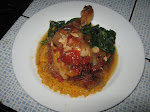
The noodles went down onto the plate first with the garlicky scented broccoli just above it. I sliced each crisp skinned breast into four thick medallions and overlapped them on top of the noodles. I grabbed a kitchen spoon and ladled the rich aromatic bacon/tomato/mushroom mixture over the top of the slices and to the table we went. It was cold out and this dish was a wonderful aromatic antidote to a rainy chilly night.

********************************
Night 2; Meatloaf ala Chef Dave; or, Calling Up Old Ghosts

I started making this meatloaf recipe in the mid-90's when I worked at the Elite Cafe on Fillmore St. in San Francisco. It started out as a bit of a derivation (read "borrowed") from a recipe used by my friend Philipe LaMancusa at Embarko in the early 90's and the one in Paul Prudhomme's first cookbook.

At the Elite it was cajun spice heavy, and we used a fairly standard gravy for it, made with a dark roux. One of the interesting adaptations that came out of the Elite was my sous chef, Steve Harlow and I mixing pureed canned chipotle chiles with ketchup and our house BBQ sauce for the glaze that would go on top. We both liked how the glaze caramelized as the meatloaf cooked, although at that time we were cooking the loaves in bread loaf pans so we weren't getting good coverage from the glaze.

The recipe took a little trip down to a N'Awlins style restaurant I opened in SF's Cannery called Belle Roux (great reviews, bad location) and was run as a special from time to time. I was fiddling with the gravy and ended up adding deeply caramelized onions to it, echoing a gravy that Philipe (once again) had put on a pork loin dish at Embarko that he called "burnt onion gravy". I used the same glaze there, but was hand forming the loaves so that the glaze would run down over the sides, lending them more of that spicy sweet caramelized goodness.

I took the recipe to the masses when I left Belle Roux and went to work as a Corporate Chef for Gap Inc. The Gap's headquarters was home to rather an upscale cafeteria/cafe and the staff was just over 80% women. That in no way kept the lines on "meatloaf day" from going out the cafe doors and wrapping down through the hallways. We would sell 12-14 meatloafs (loaves?) a day there and would be sold out by 1:00 each afternoon. Diets went by the wayside for the meatloaf and gravy over mashed potatoes.

All of this history brings us to this Wednesday past when I decided that Kathy and I would take full advantage of the packets of ground beef that were the by-product of her quarter beef purchase. I bought a pound and a half of freshly ground unseasoned pork sausage at the local market as the addition of pork makes the meatloaf moister and set out to make a recipe I had not made in at least nine years.

It's a good thing that there was plenty of bacon in the freezer because like so many other Southern/N'Awlins recipes, that's how this one starts. I cut a couple of strips in a fine dice and started them in a pan. Alongside them on the cutting board I had placed the elements of the "holy trinity"; onion, bell pepper (red, in this case, and in most cases for me; I hate the green ones) and celery. As usual, garlic found it's way in there as well. When the bacon was about half cooked and had rendered enough fat, I put a fine mirepoix of the "trinity" into the pan along with a teaspoon or so of a pre-made "cajun" spice blend. I tossed all this together, let it cook for only a few minutes and turned it out onto a sheet pan to chill.

The two packet of beef went into a mixing bowl along with the pork, two eggs, a fistful of breadcrumbs and then what else? We had some ketchup, so I added a bit of that. There was some Stubb's BBQ sauce in the refrigerator so I added a few shakes into the mix. Salt and pepper? Well, of course, along with several dashes of Lea&Perrin's, a few drops of Tabasco and lastly, the chilled spiced vegetables. I mixed all this together and patted it out into a loaf form onto a cookie pan.

The glaze would have to be a bit of an improvisation. We had no chipotle, but we had a Thai-style sweet red chile sauce. We definitely had enough ketchup and we had more BBQ sauce so all three went into a mixing bowl along with a tiny splash more of L&P. I mixed it up and brushed it on, nice and thick. I laid two long strips of bacon across the top in an "X" and the loaf was oven ready. Pretty as a picture it was (so I took one).

With the loaf in a 400 degree oven, it was gravy time. I thin sliced (half moons for me) a big yellow onion and put the slices in a cast iron skillet with a couple of teaspoons of fat I had taken off the turkey stock along with about a third of a cube of butter. The onions were set on a medium heat to cook slowly enough to keep from burning, but hot enough so that they would color; color deeply.

While the onions did their caramelizing thing, I brought about two cups of chicken and turkey stock to boil and then let it simmer. After about 20 minutes of tossing and browning, tossing and browning, the onions were starting to get some color and I was getting bored, so I turned up the heat. With the higher heat I kept tossing the onions in the pan, but was starting to get some of the crisp edges that give this gravy its distinctive flavor. When caramelizing onions, the cook wants them to be brown, limp and evenly cooked. For this gravy, I want the onions browned in the middle, but crisp and nearly (but, oh, not quite) black on the edges.

At what I considered the perfect point, I added a handful of flour to the pan and using a wooden spoon, coaxed it into the liquid fat that surrounded the onions. It thickened quickly and then, as happens, it fell into a softer form as a bit of the liquid from the onions worked its way in. Now it would be like cooking a roux, much like one would for gumbo or other cajun stews.

I tossed and mixed the onions and roux until the color of the roux was nearly like a dark peanut butter; a really dark peanut butter. Very, VERY, carefully, I poured the simmering stock into the skillet and still using the long wooden spoon, stirred the mixture until it was "as one". Still stirring, I brought the gravy to a boil and then reduced it to a low simmer. The browning would have cooked most of the flour taste out, but the gravy now needed a long slow cooking to incorporate all the flavors.

I left the gravy on a low heat to slowly commingle the flavors and turned to the loaf at hand. It was nearly done and I knew that it would need to sit and repose (or reposee, as they say in France). I find that most meatloaves, despite being wonderful straight from the oven, may be better the second day after all the juices have redistributed themselves in the tiny crevices in the meat.
But we were eating it that night and so it would have to rest for as long as we could let it before we had at it.

Mashed potatoes were and are the obvious accompaniment to meatloaf and gravy and I had yukon golds peeled and in the water and boiling away. I keep a jar of roasted garlic cloves in the refrigerator for moments such as this and they awaited their fate of being mashed in with the finished spuds. I had been craving asparagus even though the locals are not quite here yet (late, late Spring) so caved and bought some Mexican product; please don't tell a soul.

The gravy had reached it's desired flavor and doneness, the spuds had been mashed (along with the roasted garlic cloves) and anointed with butter and cream; the asparagus were simmering lightly in a bath of butter and sauteed garlic. All that remained was to put that first cut in the loaf and put the plate together. I broke through the crust and glaze with a sharp knife and was greeted by a waft of steam and a seductively spicy aroma. The mashers went down on the plate surrounded by the asparagus. The slabs of meatloaf went right on top of the potatoes and a generous ladle of gravy covered it all. Dinner was on; really on.

We enjoyed (I enjoyed) this dinner more than anything that I've cooked in quite some time. It may have been nine years, but it was every bit as good as I remembered. Costa Rica may have steered me a bit off meat, but this loaf was divine, heavenly and yes, delicious.

*****************************************
Night 3; Finally Mexican

I grew up in California and have always loved Mexican food and cooking with Mexican ingredients. I made my first chile rellenos over 40 years ago and perfected a tomatillo "salsa verde" for crab or chicken enchiladas that my sisters both still use. Mexican culture is so deeply entwined with the cultures of both California and Texas, both states where I have lived and it has always been an undercurrent of flavor and style in my cooking.

For nearly all of my time in Costa Rica I drew on influences from Mexican cuisine. I made fruit salsas based on the the "pico de gallo" model; I made guacamole using just fresh avocados, lime, chiles and cilantro; I made vegetarian stuffed chiles that were not too different from my early chiles rellenos and I used Mexican techniques for braising pork with citrus and chiles. But, I have not cooked any real Mexican food in a long, long time.

This week we had big chunks of leftover turkey in our refrigerator from a whole turkey breast that Kathy had braised in the crock pot. I needed a way to use it up that would get us out of the flavors we had been currently eating, and I needed to do something that would get me on a different track. Mexican was something I had been missing, Mexican was something I had been craving and Mexican it was going to be.

The last time I had made Turkey Enchiladas was in Austin two and a half years ago with some Thanksgiving leftovers, but then I had used my old standby green sauce. This time I wanted to find some good quality dried chiles and do a traditional red chile enchilada sauce. It took a little hunting to find the chiles I wanted, but a very helpful young gentlemen in the produce department at Safeway pulled a box of loose packed dried New Mexico chiles out and let me rummage through them to find what I wanted. In addition I bought a pack of dried ancho chiles to balance out and deepen the flavor.

To start the process I heated a cast iron skillet to take the place of the traditional Mexican "comal" and toasted the chiles on each side before immersing them in water to rehydrate. I used the same hot iron pan to dry toast thick slices of onion, halved tomatoes and unpeeled garlic cloves. When each of them were toasted I put them in a blender (I peeled the garlic after toasting) along with the rehydrated chiles that I had stemmed, seeded and torn into pieces. When I blended it all with some of the soaking water, it turned into a beautiful deep, thick, rust colored liquid.

The next step is to lightly "fry" the sauce in hot oil. It seems odd to "fry" a liquid, but it helps to take the raw flavor out of the chiles and intensifies those flavors as well. When the sauce hits the hot oil it comes to a quick boil in the pan. I then turn the flame down and let the sauce simmer for nearly an hour. The smell is haunting and ever so familiar.

I cut and tore our leftover turkey breast into pieces and chunks and put it into a bowl along with cubes of avocado, shredded Monterey Jack cheese, some minced green onions and a healthy ladle of the newly made red sauce. When mixed together, this would be the filling for the enchiladas. I next dipped each white corn tortilla in the hot red sauce to soften it so that it would not tear in the rolling and proceeded to roll up six tortillas. I coated the bottom of a pyrex with more sauce and laid the finished enchiladas in the pan. Another thick coat of the red sauce went over them and then a flurry of grated jack cheese. A layer of foil over the top made our enchiladas oven ready.

While the enchiladas baked I prepared a simple white rice that I mixed with a handful of chopped green onions and cilantro. I anointed a lettuce mix with just lemon juice, olive oil, salt and pepper and left it to toss when the enchiladas were ready. I took the foil off the enchiladas after 25 minutes and gave them another 15 minutes in the oven so that the cheese took on a nice golden brown color. I pulled them from the over steaming and beautiful.

The plate was simple but colorful; the red of the enchiladas and their sauce, the simple green salad and the speckled green and white of the rice. Kathy and I took out first bites of the enchiladas and it was hauntingly familiar; slightly bitter but with hint of sweetness, spicy but not too, and deep with flavor. I had put a dollop of sour cream on top of them when I had put them on the plate and the blandness of the cream and the turkey/avocado filling were the perfect foils to allow the bite of the red chile sauce to shine through. We powered through these and barely spoke while we did.

It was such a pleasure to experience this classic flavor once again. It brought back so many taste-bud and olfactory memories which in turn sparked a host of thoughts of other meals and other times.

It is one of the powerful properties of food and cooking that it can take us back to so many other places. These three meals each called up flavors from my cooking past and allowed me to revisit and re-practice techniques which will never leave me. It is amazing how a trip to the freezer and the need to rid ourselves of left-overs can open the door to the past and help to remind us that the skills and the flavors are always there.


Wednesday May 13, 2009 La Cusinga and Me


This words below are from our website describing La Cusinga.  The story, however is much deeper and much richer than these introductory words can describe.  La Cusinga represents a noble and successful effort to preserve this section of unspoiled coast and to keep it alive as a model of what true ecology can accomplish.  The dreams and visions of John Tresemer, the owner of La Cusinga and the Finca Tres Hermanas that surrounds it, have been realized here in what is a true example for all who would preserve and protect what remains of this, or any natural wonder. 

La Cusinga 
La Cusinga Lodge is a coastal rainforest eco lodge dedicated to marine and terrestrial conservation and environmental education. Its location on the southern Pacific coast provides guests with sweeping ocean views and a relaxing beach vacation. In addition La Cusinga is part of a private nature reserve that supplies the visitor with an unparalleled look at Costa Rican wildlife and rainforest. The reserve consists primarily of 250 hectares of virgin rainforest that borders thousands of more acres of privately protected forest. On Costa Rica’s still wild south-western Pacific coast, La Cusinga Lodge borders Ballena Marine National Park which was developed to protect the humpback whales that frequent the coast. La Cusinga Lodge was established in order to share the unique site with Costa Ricans as well as international visitors. Besides getting exposure to rural Costa Rican culture and beautiful vistas, visitors have access to highly prolific areas of primary tropical rainforest and unspoiled coast, all conveniently accessible. 

i returned to La Cusinga this past January, 2009, with a dream in mind.  I wanted to create a cuisine for our guests that would bridge the gap between what La Cusinga offered physically and spiritually, and what they were putting in their bodies when they ate here.  I knew from having previously lived in Costa Rica for over two years that there were organic farmers and that sustainable agriculture was being practiced, but at that time it had been limited in its scope as well as its distribution.  

My first steps upon returning were toward the local Feria to seek out and communicate my ideas with the growers and vendors who could provide me with a local, organic and sustainable product.  The fertile valleys of San Isidro that lie over the coastal mountains and to the Northeast of our Pacific location are rich and productive but are only now exploring the potential that they hold.  

I had in mind a vision that would support local farmers, fishermen and food artisans and one that would recreate (or perhaps, create) a new cuisine of Coastal Costa Rica.  I visit the markets each week to talk with growers and to develop the  relationships that I believe will be mutually beneficial as Costa Rica experiences its rapid growth on an international level
.
Organic farming is a new and not heavily supported concept in our part of Costa Rica.  It is a brave step for farmers to make, as local communities of both growers and consumers have never placed, or not known to place, an importance on farming organically and sustainably.  I feel a responsibility as a Chef here to be at the forefront of those encouraging and supporting these pioneers  

I came to La Cusinga almost three years ago not knowing what to expect.  My first time through here was characterized by a lack of understanding and appreciation on my part as well as an inability to recognize or connect with the local "flavor" that would make for a coherent package for out guests.  I now feel as if I have made a "connect" with the property and the vision.  I am not completely satisfied and hopefully, never will be, until we are able to produce, right here at La Cusinga, the greater share of the produce we serve.  However, the groundwork has been laid with local farmers and the availability and quality of organic produce is impressive.

Now at La Cusinga I serve a variety of organic lettuces and braising greens.  My salads include wedges or slices of rich red tomatoes as well as sweet !00 and yellow pear cherry tomatoes.  I roast organic beets and marinate them in balsamic vinegar to be served alongside the lettuces and topped with a locally made organic goat cheese.

My soups are made from roasted and steamed local organic vegetables and tiny organic yellow creamer potatoes have found their way onto my plates, nestled against filets of locally caught fish.
I am now using a local organic cocoa powder that still contains the nuggets of cocoa butter unlike the fined cocoa powder in the markets.

And better still, I am able to use palmito (hearts of palm), ginger, cilantro and its sawtooth leafed cousin culantro coyote, mangoes, hot and sweet chiles, mandarina limes and yucca root from our own Finca Tres Hermanas to serve in my dining room at La Cusinga.   The connection from jungle and farm to table is evolving.  May it continue to grow.