Thursday, October 29, 2009

This is the second installment of the story of the opening of the Lily Pad, the restaurant at the Lookout Hotel in Ojochal, Costa Rica, in November of 2005.

NIGHTMARES IN COSTA RICA

OPENING THE LOOKOUT PART 2

I was in the jungle, but the cold sweats and the gnawing had started again. Here I was, standing alongside a long series of ramshackle buildings, odd and ancient machinery; wondering, yet again, what in the world is going on. My Ford Ranger 4X4 had cracked and broken a brake drum and the horrors of trying to get if fixed in a country that seems to never have heard of “Ford” coincided not so nicely with the legwork and prepwork involved in the last two days before opening a restaurant. Anywhere.

Our good friend Olman had a solution, since he always had a solution and dragged us along to the taller (garage) where his brother worked. This was a most unusual taller in that it was housed in the long narrow buildings that had been constructed specifically by Dole, the canning and fruit giants, at the turn of the century (no, not this one) as a workplace for the men who fixed the banana trains that Dole ran through the jungles from coast to coast.

Because it had been constructed to fix the trains of yesteryear, this particular taller had a lot of features not normally found in the garages that we’re all familiar (or not familiar in my case) with. One of the more remarkable of these massive tools was a metal press that could be used for fabricating steel parts that had become unserviceable. And so it came to pass that since Ford parts are virtually unobtainable in Costa Rica, George, brother of Olman, was going to use my broken brake drum as a template and make a brake drum for me, right there in the taller.

I was severly apprehensive at at the potential cost of this “new to me” venture and cautiously asked “cuantos” and sort of winced at the same time. George looked at me solemnly and declared, “Ocho mil colones, mas o menos”.

Huh? It was going to cost me in the neighborhood of $16 for him to make me a brand new brake drum, on this veryt spot. I was more than happy to do a bit more shopping while this feat of engineering was being performed and when I returned in the proscribed hour, the brake drum was made and on the truck. The work and the price had me stunned; stunned. I got back in the truck with a stll slightly baffled shake of the head and drove back up through the jungles to Ojochal and the Lookout.

Driving back I stressed and sweated and worried and stressed and sweated some more. I was trying to get a kitchen open yes, but there was more to it than that. I had chosen this particular time to try to “do something” about my increasingly problematic and prolific drinking and for some reason thought that the work involved in getting the restaurant open would provide the distraction from, and the channel for, the demons crawling inside my brain and an under my skin. The fact that I already had sweated through two tee shirts and was letting my brain run wild with worry was evidence that distraction was not immediately at hand.

When I backed the truck up the entrance to the kitchen, my entire “crew” was there. The slender and shy Betza; her opposite, the roly-poly and smilyfaced Katya; and enigmatic and stonefaced Randall. Randall was the only one of them with any restaurant experience and had, in fact, worked in our kitchen with previous owners. Randall had ridden up our rutted and steep driveway on his bicycle, appeared at my back door in a short sleeved chef’s coat and asked for a job almost two months earlier. I had told him there was no work yet , but he appeared at least twice a week for the next eight weeks, always in his slightly sweat-soaked chef’s coat and I couldn’t help but admire his dedication. He was definitely going to be my right hand man.

Groceries put away, we set to the food prep. I wanted to get all the basic sauces and dressings made so we fired up the smoker for smoking the tomatoes and hot chiles for one sauce and pulled out the food processor to start making vinaigrettes and dressings. The Cuisinart was a wonder to my two country girls and they oohed, awed and reeled back in fear from its spinning blades. I had put Randall on a longish vegetable cutting task, and had taken it upon myself to attempt to explain the dressings (try describing an emulsion in a foreign language) and the salad and first course set-ups to my two willing charmingly clueless Ticas.

I should probably stop here and explain to my readers who may be as “at sea” as my cute little student cooks, that an emulsion is a cooking technique whereby two things that are “unlike” become one through means physical and/or chemical. A classic example of this is oil and vinegar being bound together to make a creamy dressing (emulsion), with the addition of egg and/or mustard. The vinegar added into the egg forms an acidic base that will hold the oil (when it is added quite slowly) in suspension.. Mayonnaise is an emulsion. Another example of an emulsiton is Hollandaise sauce, in which melted butter, lemon juice and egg yolks come together in a rich, creamy sauce.

There we were, the three of us huddled over the Cuisinart while I wiped away the sweat, the olive oil and the flecks of flying egg yolk. I was well on my way to soaking through yet another shirt and had a good case of the shakes that my rookie helpers couldn’t help but see each time I lifted the oil bottle to drizzle the oil into the whirling would-be emulsion. And it didn’t get any better when I went into our walk-in refrigerator to take deep breaths and try to slow it all down because my fully soaked shirt was clinging immediately and clammily to my torso,, chilling me to the bone. If I could just get through today, then…

Ah, but onward. I had to finish the sauces and the first truck of the day (hallejuh, the phone calls to those faceless and happy Spanish speaking voices had worked) was pulling in with the dry goods delivery. I checked the smoker where the tomatoes and chiles were getting an even char and a nicely smoky scent permeating. These would be pureed with roasted onions and garlic to make a Spicy Smoked Tomato sauce for grilled fish. It was time for another shirt change and I could feel my stomach, my brain and my entire being calling out for just a short shot (if not a tall shot) of rum and a beer to get me though.

Aside from Randall’s heavy chopping, it was me, me, all me doing this necessary prep work. The girls were cute and the girls had nice smiles, but they were otherwise useless. Thank God I had decided to open with a small menu to protect myself against situations exactly like this one. They stood back and stared with what I can only presume was a sense of horror as I sweated, mumbled and cursed through the whizzing and whirring that would yield me four different sauces. My shirt was soaked, my face was red and greasy and my hair, although tied back, was slipping from the rubber band and plastering itself against my forehead.

“This” was certainly not what I had envisioned those ocean view, tall drink, tropical dream months ago. What “This” was was a greasy, disorganized, brainaddled, detox hell. A twisted version of opening a restaurant in a foreign country in a foreign language with a work crew who were certainly foreign to whatever it was I was trying to accomplish. But it was almost done, at least on this, the Day Before, and I’d treat the girls to a coke, Randall to a cold Imperial, slam another quart or two of water myself and try to figure out just what we (I) had to do to keep from deeply embarrassing myself on Opening Night.

Monday, October 12, 2009

CHEF OF THE JUNGLE

This is the first piece, and accompanying recipe that I did for the Dominical Days November issue. I am limited to 320 words per column which will certainly help my editing skills.

Chef of the Jungle

Greetings and thank you for joining me for my inaugural column. I am presently the Chef at La Cusinga Lodge and have cooked professionally for my entire working life. I will call upon my experience in the food world to give support to what I will write here, but I hope to keep my comments and thoughts directed more to the food around us rather that to what is cooked professionally by me or those in other restaurants.

My focus here will be more toward my passions for cooking, and the practices of eating locally, organically and supporting those who practice sustainable food production. Upon my return to the Costa Ballena this past January I took it upon myself to search out, to source as much locally grown, produced and caught food as I could in an effort to throw support to those who were struggling to make it available to all of us.

The term “local-vore” has cropped up to describe those chefs and cooks who attempt to use as much product within a limited radius as is possible.

The benefits of this practice are many. By buying locally we support our local economy, help sustain our farmers and fisherman, and perhaps most importantly, gain a closer relationship to and knowledge of where our food comes from. A head of lettuce with the roots still attached is more reassuring that one pulled, sweating, from a plastic bag.

Here on our coast we have access to so much beautiful local and organic food.The Feria in San Isidro is just over the hill and local farmers are now selling their products in Uvita. We can buy “fresh from the ocean seafood” up and down the Costanero and pull fruit right from the trees. We, the consumers, are the ones who can support “local food” and by doing so,will ourselves, “reap the harvest” in so many ways.

ROASTED STUFFED AYOTE

Ayote is a local squash; round, with the coloring of zucchini, it has the seed structure of a pumpkin or other winter squash. When it is hollowed out it makes a perfect vegetable to stuff with any number of savory fillings. This one is simple and makes use of cooked food on hand. The chorizo and hot chile are, of course, optional.

This makes a great and complete dinner when served with a nice salad.

1 Ayote

1 Yellow Onion, diced

1 Red Bell Pepper, diced

4 Cloves Garlic, peeled and minced fine

½ hot chile, seeded and minced fine

½ # hot or mild chorizo

1 Cup cooked rice

1 Cup cooked beans, black or red

½ cup shredded cheese

cooking oii

Heat oven to 350

Cut stem end and opposite end off the ayote so that it sits flat

Cut it in half around the hemisphere and using a teaspoon, cut around the seeds and scoop them out. Using the edge of the spoon hollow cut more of the ayote away until only about a half inch of flesh remains near the skin. Rub the inside of the ayote with oil and salt and pepper it.

Place the ayote cut and open side up on a cookie tray or in a sauté pan and roast 30 minutes, or until tender. Turn ayote over and roast for ten minutes more, until ridge around the center is golden. Remove from oven.

While the ayote is cooking brown the chorizo; add garlic, onion, peppers and cook until tender. Stir in rice and beans and mix gently. Sprinkle the cheese in (reserving a little) and mix until blended.

Stuff the ayote with the bean/rice/cheese mixture and top with reserved cheese.

Return to oven and bake for an additional 30 minutes, or until heated through.

I like to serve this with a fresh tomato sauce or a simple salsa fresca

Wednesday, September 30, 2009

RESTAURANT DREAMS/NIGHTMARES

The following are a series of vignettes, glimpses and flashbacks from an American Chef trying to open a restaurant in Costa Rica for the first time. PT. 1

Although we had all arrived from San Francisco in early September, the restaurant and hotel were not ready to open to the public until mid-November. The scraping, painting, bribing and learning experience had taken us that long and perhaps should have taken longer. We opened the hotel first for friends and family and then prepared to open the doors to “The Lily Pad” restaurant, named after the owner’s one year old daughter.

I had been testing menu items (again for friends and family) for weeks and like the veterans in the NFL’s Pre-Season, I was champing and chafing for some live action. My menu was simple; five appetizers/salads and five entrees with nightly specials to feature fresh fish. We put out the word in our small coastal community and the response was overwhelming. We had 42 reservations for a dining room that held just over 30 and we would have to set up tables in the bar area as well. It was two days before opening and we had virtually no waitstaff, a novice bartender and a kitchen crew had who never worked together or even been trained; our budget was as bare bones as it gets.

When we (much more than naively) began this venture we had no idea of the frustration, heartbreak and pitfalls attempting to do business in a Third World country doesn't just present, but throws in your face in a repeated and somewhat numbing fashion. Imagine, if you will, the prospect of opening a restaurant in the states with no vehicle, and working telephone; no fax, no internet and no one on the selling and providing end who seemed to care whether or not we bought from them, or whether or not we failed miserably.

On the day before we are to open, all the food has been ordered or run out for; or in some cases, begged for. We waited with the faith of children for the trucks to rumble up our driveway bearing the necessary items (milk, juice, flour, oil!) that one would deem necessary but ridiculously simple to access anywhere else but here on the south Costa Rican coast.

Attempting to get deliveries where we are, and bear in mind it's even remote for Costa Rica, is perhaps one of the most frustrating experiences I've ever encountered. When one is able to make phone contact, the company on the other end happily tells you that someone will be there manana and then no one shows. You call them the next day, if and when the phone works, and they remember you, greet you with great joy, and happily tell you that the truck or representative will be there manana. This call and response can last the entire week.

One of the interesting facets of deliveries here is that most of the drivers are their own businessmen. You order from the driver and you pay the driver. Only two companies, the dry goods people (who are notorious for never even showing up to take the order), and the beer company (who it seems stop by almost every day) send a representative. One finds oneself driving up and down the Costanera Highway (when one has an operable vehicle) desperately searching for the Coke truck, or the Dos Pinos (dairy) truck, or whichever particular supply you are either running low or out of and begging the driver to stop by when he's a little further toward your end of the route.

I had spent the day before the grand opening of “The Lily Pad at the Lookout Hotel” running and sweating trying to get everything I would need to keep me from having to leave my kitchen at any point of opening day. Unfortunately, this running also included having to be driven to where my moneypit Ford Ranger 4X4 was in the shop (again), and was promised, promised to me for this, the most important of days. It wasn’t ready so I embarked on the final assault on food procurement via taxi and on foot. I was in the town of Palmar, a dusty beaten town known primarily for cold beer and the only whore house in the vicinity for kilometers and kilometers.

Palmar also boasted the carneceria (butcher shop) of smiling David, my favorite three fingered (well, three and half if you’re really counting) butcher. And although he and I had built up a pretty good relationship based on our shared knowledge of the workings and subsequent disassembling of pigs, I had yet to summon the courage to ask him just how it was that the dedos (fingers) came to be missing. I did however, avail myself of he and his fine quality swine products. I also liked visiting David because he would let me come around behind the counter and swing a cleaver or slice with the scimitar knife with him. You don’t get a lot of that back home.

In any case, I picked up four beautiful center cut pork loins and their attendant (but separated) rib bones, a couple of long skeins of smoked chorizo and a few kilos of bacon (tocinetta). I had made the mistake on my first visit to David of ordering tocino, which my old friends in Mexico call bacon. I was taken back a bit that first time when I looked in the bag and saw caul fat, the membraned fat that lines the pigs’s stomach. Turns out that in Costa Rica, that is what passes for tocino. David reminds me of my folly each time I visit and I remind myself not to mention the missing fingers.

I move on to the produce stand where I pick up a pre-arranged order and stop in at the grocery to try to find any kind, any kind of flavored vinegar that is actually made from a wine product. Good luck. Oddly, it's all artificial here, a vinegar concept I was unfamiliar with.

I am nervous about the truck being ready, but equally nervous about what might be going on back in the kitchen while I am not there to direct traffic, offer chefly advice and do all I can do to prevent crimes against food. I have recipes and I have talked ideas, but there the food sits and what if, just what if they were to take some initiative and start in on their own? This turned out to be an unfounded fear.

The labor pool for cooks here in our rural jungle location is pretty damn slim. I have interviewed plump abuelas (grandmothers) in aprons, hard faced single moms who cook the local bean and rice “gallo pinto” at greasy sodas (the local diners) and a succession of willing but oh, so young, Ticos, mostly girls. I have hired three locals; Randall, a 26 year old (he looks 15) who has experience cooking, and has in fact, worked in this very kitchen for previous operators; Betza, an 18 year old slim-hipped beauty who has no previous food experience, but is bright and attentive; and Katya, another 18 year old, who is as roly-poly as Betza is slim, and is the angel faced mother of a 2 1/2 year old son. Explaining my food to them has already been interesting, frustrating and confusing to both them and me. Now getting back to the restaurant to get them to prepare my food correctly is the huge remaining challenge of the day.

Wednesday, September 23, 2009

GIVE 'EM WHAT THEY DON'T WANT

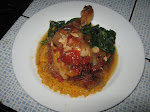
THE JOY OF CHICKEN LEGS

One of my delights and minor perversities in cooking is getting my guests to eat things that they wouldn't normally try (or that they think they don't like) and having them enjoy them. I try to put at least one vegetable on every entree plate, for example, that is either unfamiliar or has gone untasted due to early life prejudices. I use a mix of organic braising greens that contains three different kales, mustards and amaranth; all greens normally uncooked in the typical household. I have also made it a point to serve either ayote or baby chayote, two local and relatively unfamiliar squashes at almost every meal. It is ironic how many people still cling to notions about various foodstuffs that were brought on by the kitchen crimes of their childhood.

Lately I have offered two entirely different dishes that are not way up there on the cravings lists of people, but have been gobbled down by our La Cusinga guests with great gusto.
The first of these is chicken legs. I must confess, and speaking as a chef, that the American trend toward skinless boneless chicken breasts, eaten in the interest of health, was one I found appalling. I was in a relationship for years with a woman who would not eat the dark meat of the chicken, the meat that I found to be the richest and most flavorful. And I found that peculiar.

There was a period of time, several years ago, when I had searched for a way to cook duck legs in a way that would mimic "confit"; the process of cooking duck slowly in its own fat until the meat nearly fell away from the bone. I came upon the notion of braising the legs in wine, herbs and liquid in the oven at a medium heat for an hour and a half or so, until they were at that "fallin' of the bone"point. And once I got there, I realized that it was going to work equally well for chicken. It would give a crisp skin (for those who still deign to eat it), tender flavorful meat, and contribute a rich sauce as well.

I have been buying fat and tasty organic chickens from Mauren and Alomar, my organic farmers, and damned if I was going to let those lovely legs go to waste. Each chicken wears two breasts and two legs and in order to make back my money and completely utilize my chickens I was going to have to sell, and sell my customers on, those legs. Overcoming the (particularly) American notion of only wanting the chicken breast calls for a cultural and societal (not to mention class oriented) upheaval of ideas, but I was ready for it. To the ovens I went, the braising notion full in mind.

To begin, this past Sunday night, I salted and peppered the whole chicken legs and put them in medium rondo (round medium-high sided casserole) to brown and began the search of my refrigerator for the flavors and add-ons that would create the sauce, and ultimately "make" the dish. I found a container of organic tomatoes, onions and garlic roasted in olive oil and I was there. I already had chicken stock and some white wine that a guest had left and that was all I needed.

I pulled the legs out of the pan once the skin was golden and crisp and poured off the fat. After renestling them together in the pan, I waited for the pan to get sizzling hot and poured in a cup of white wine. I let it boil up and suck the flavor from the bottom of the pan and then added four cups of my rich chicken stock and a couple of healthy spoons full of the roasted tomato mix. This liquid came up the sides of the legs so that just the skin was visible and I brought it all to a boil. Once the liquid and "future sauce" in the rondo was aboil, into the oven it went at 400 degrees, until the legs hit that perfect point of tenderness.

Now I needed the perfect bed to lay my chicken in; something to absorb and accept the rich bold flavors from the braising sauce. I have used rice, risotto, polenta and even pasta for this noble yet humble role, but tonight, it was going to be what I consider the perfect match; mashed potatoes. And not just any old mashed potatoes, either. I had whole cloves of roasted garlic and I also had beautiful potent basil leaves from the La Cusinga gardens. Butter had been pulled out to soften and all of these ingredients went into the food processor to become "as one"; a compound butter to bring those basic potatoes to life. And while the machine whirred and the basil and garlic integrated and insinuated themselves into the butter, I poured in just a bit of extra virgin olive oil to "help" with the richness and smoothness.

At the end of about 75 minutes I could see the skin at the "ankles" of the chicken legs pulling away from the bone. These babies were ready. I pulled the rondo from the oven and set the peeled potatoes on to boil. I gently lifted each leg from the chunky crimson broth and put them on a plate. I tilted the pot slightly and could see the fat from the chicken collect on one side. I spooned as much of it off as I could, gave the sauce a stir, admiring and savoring its rich smells and laid the chicken back down inside.

The potatoes had reached the point of nearly falling apart when I drained off about 90% of the water, leaving a bit in the pan. I set the pan on a medium flame and dropped in several softened chunks of the basil-garlic compound butter. I could smell the richness of the herb as the heat opened it up. I smashed in the butter, added a cup or so of milk and checked for salt. Yum, these mashers were GREAT! I set up a bain-marie for the potatoes and awaited my guests.

I had slender organic green beans and fluffy leaves of locally grown tri-color chard for the vegetable accompaniments and I sauteed and steamed them respectively as my guests worked their way through soup and then salad. I had returned the chicken in its sauce to the oven to re-crisp the skin and to bring it back up to heat and it was ready. A rich dollop of the pale green mashed potatoes went onto the plate with a scattering of the green beans and a pile of he steaming and garlicky chard. And then the chicken; mounted atop the potatoes with a spoon of the rich tomato-chicken sauce over the top and oozing down, surrounding and soaking the potatoes.

I took a picture. I had to, it was a beautiful plate; and then I served it to my guests, all Americans. I only had to check in once to see them eagerly spooning the mashed potatoes and sauce into their mouths and to notice that yes, the meat was coming easily from the bone and yes again, the bones were nearly bare. It appeared I had overcome the "leg prejudice" with guile, cunning and just plain good flavors. That'll do it every time.

GOAT CHEESE CHEESECAKE? YES!

I have a particular fondness for goat cheese, but am well aware that it is not as well loved by others as it is by me. In my time here in Costa Rica I have bought several different types and styles of queso de cabra with varying degrees of flavor, texture and overall appeal. The style that seems to be most successful here is a fresh cheese, not overly aged or "goaty" and almost like a dense ricotta or even a moist feta in texture. I've bought a few of the dryer and more and more aged versions but found them to have lost a great deal of flavor in their drying. I liked the fresher cheeses.

After several purchases form different cheese makers and with wildly differing results, I had become a little frustrated and when my regular and best connection stopped production due to "mal leche", I was stumped. My asking around the San Isidro Feria brought me to Chris, a smiling and affable gringo with a goat cheese that I had bought in the past but thought flavorless. It turned out, after a bit of questioning, that he was not particularly "married" to his current goat cheese recipe and was having trouble selling it. He was amenable to turning out a batch for me to be available in a week so off I went.

The first batch from Chris was moist and crumbly; too wet, really. The flavor was mild, but almost too mild. I wanted it to be sharper, more acidic. So we went into Week 2 and Batch 2, which turned out to be somewhat better but still not quite there. Chris was adding a buttermilk culture to the cheese and had been afraid to go too far. "Amp it up", I said and awaited the results of Week 3. And it was just what I wanted; bright enough in flavor to cut through the mild lettuces I would serve it with and excellent for pairing with either roasted beets or sliced salted tomatoes. Happily and eagerly I took it back to La Cusinga to play with.

Chris was making a 1.4 kilo batch of cheese each week and I was buying all of it. I needed to find ways to use this great fresh cheese other than just pairing it with salads. Off to Google I went and perused all the goat cheese recipes it had to offer. I wasn't much inspired by the hot or baked cheese recipes I came across, but when I saw a recipe for a goat cheese cake, I stopped and pondered. Would it be any good? Would my guests go for it after I'd spoiled them all these months with various cakes and ice creams? Who knew, but why not?

The recipe called for 12 ounces of cheese creamed out with white sugar. I immediately dumped the white sugar idea and used tapa dulce, the local natural sugar made from the boiling down of sugar cane. I could see it was going to give it an interesting color, but that was fine. Now it would be "my" cheesecake. I added the zest and juice from a couple of mandarinas and a splash of vanilla. The recipe called for six eggs, separated, with the yolks added to the cheese and the whites beaten to stiff and folded in just before baking. The mixture seemed light and too liquidy to me, but into a buttered and tapa-dulced pan it went and into the oven for a mere 25-30 minutes; no water bath, no nothing.

The cake rose like a souffle from the egg whites and once out of the oven, fell gently in the pan. I let it cool just slightly and turned it out onto a sheet pan. It was great looking, a pale tan color and shiny on top from the sugar. I slipped it into the refi to cool through and thought about how to serve it. It needed fruit and I couldn't decide if I wanted it to go with the blackberries I'd bought that morning or something different; more tropical. I decided after a bite or two that the moras (blackberries) were too seedy and too tart; I'd save them for ice cream.

I wanted mangos. A mango sauce to spoon over the top. And so I cubed ripe mango and tossed it with yet more tapa dulce so it would make a sauce as it sat, and also a bit of local organic honey. The cake and the sauce both rested, but I didn't. I thought about cheesecakes and what made them appealing and remembered sour cream. Here I buy a local organic sour cream called natilla from a muy amable gentleman at the Feria named Mario. I decided that instead of smoothing it over the top like an "old school" cheesecake, I'd just gently spoon it down over the mango sauce.

And that's how I served it that night. A nice slice of the cake, smooth and easily cut; a generous spoonful of the sweetened and saucy mangos, and a soft spooning of the slightly runny natilla drizzled over the top. My guests had reacted somewhat predictably when I had informed them of their (only) dessert option for the evening. There was the "I don't really like goat cheese that much" response and there was the "bring it on, I love cheesecake" response. All the plates were cleaned, so it seemed as if it had crossed the boundaries and borders that would keep people from liking it. It was and is a keeper and has become part of the dessert rotation at La Cusinga. I also have a viable and delicious way to help move 1.4 kilos of goat cheese through my refrigerator each week.


Monday, September 14, 2009

FINCA CAROLINA

FINCA CAROLINA

A week or so ago, I bought a kilo of some beautiful organic lettuces from Andrew Ogden, the owner and farmer at Finca Carolina. It was a pleasure to open up the bags of the carefully cut leaves and see the colors and textures of the mixed greens. Andrew is a neighbor of mine where I've been housesitting on La Union road this past three months and Finca Carolina is his dream. The Finca sits on the edge of a canyon that overlooks a river, hiking trails and gorgeous waterfalls. Andrew's living structures are scattered along the hillside, but his tented raised beds are at the center of his living area.

Andrew is an American with a degree in Anthropology and Environmental Studies. He is tall, lanky, soft spoken, and yes, also a surfer. His dream is to create a working farm/environmental study facility that will draw students, classes and environmental tour groups to his hillside jungle property. The raised beds and organic vegetables that Andrew grows are just part of his vision. And while for a chef like me, his lettuces, chard, yuca, spinach and other crops are the draw, his real vision is the complete use of his property to promote environmental awareness.

Finca Carolina is currently working with interns and student groups who want to study the micro-climate that exists there. Andrew's agricultural interests are not limited to vegetables and the trails are lined with fruit trees and native plants that yield crops long used by the Ticos. Aditionally Andrew is beginning the process of growing and harvesting vanilla beans; an arduous endeavor.

As a Chef it is my desire as well as my responsibility to buy locally and support local farmers in their efforts to bring a foundation of organic growing to communities where it has not previously existed. And it is pioneers like Andrew who will help to make chefs and local buyers as well, aware of the need for all of us to support local crops and farmers. This is our future and both farmer and chef need to do their parts in building awareness among not just consumers, but those in both of our industries. The success of Andrew and Finca Carolina are a small step, but a vital one.

Tuesday, September 8, 2009

THE BIG FISH

THE BIG FISH

THE BIG FISH

Yellowfin croaker (Umbrina roncador) is a species of croaker occurring from the Gulf of California, Mexico, to Point Conception, California. They frequent bays, channels, harbors and other nearshore waters over sandy bottoms. These croakers are more abundant along beaches during the summer months and may move to deeper water in winter.

In Costa Rica, Corvina is a name given to almost any white-fleshed fish caught just off the coast, in and around the waters that surround the floating islands of mangroves, and sometimes deeper in the Pacific. Corvina in the US is frequently used as a name for a specifically colored sea bass, but looked different from what I had seen here. I had been buying "Corvina" from Victoriano for a while and noticed that it frequently had a golden/yellowish cast to the fins and along the spine as well. A little Googling got me a few pictures of what closely resembled what I have been buying and I believe that the fish mentioned above, the Yellowfin croaker, is indeed what we here in Costa Rica call Corvina.

A couple of Fridays ago I took drive down the coast through the overhanging palms and alongside brilliant flashes of electric blue from the Pacific to Ojochal where Victoriano, el pescadero, fishes and lives. Once one leaves the smooth paving of the Costanera, the side road down to Playa Tortuga becomes a pockmarked gravel pit, particularly treacherous in the rain. The road winds and bumps itself all the way out to the two tiers of beaches that got their names from the turtles that have come to the sands to lay their eggs for time immemorial (but perhaps for not too much longer).

Well before those rich white dunes, however, and, in fact the first buildings that one comes to, is the compound of Victoriano. Victoriano's house is a small rectangular structure and is, by no means the center of civilization of his little community. Around the house is a collection of debris both useful and not; car parts, refrigerator parts, tires, slabs of concrete and so much more. Off to the right are old chairs where I have often found Victoriano on Sunday sitting quietly, spectacles on, reading his bible. Almost in the center of the compound is a massive, above ground, concrete firepit, overhung by a small roof that just gives it cover from the frequent rains. Almost every time I visit, one or the other of the family is tending a fire, frying fish, grilling meats, or all of the above.

At the back of the compound and butted up against the river that runs out to the ocean is what I am here for.
Perched on a ten foot by twenty foot concrete slab are two aging and rusted "coffin" style refrigerators. Beside them is a crude cutting table and around on the floor are buckets, hoses, plastic bags and plenty of fish scales. At the end of the cutting table is the scale. When the fish are running and the catch has been good, Victoriano, Jaime (his partner), or Maria (his wife, whom he lovingly calls "Gorda") will fling back the lid of the main cooler to exhibit a pile of whole fish, stacked like logs and packed in crushed ice. The rotation of product here is rapid and the fish gaze upward, flesh firm and eyes clear.

The catch is limited to shore fish, but this only leaves out tuna and dorado from the broad selection that Victoriano displays. I love to see the red faced and red finned Pargo (red snapper), with their giant heads and vicious teeth; the long snouted and faintly yellow-tinted Rovalo (snook); the myriad of smaller mackerel and sharks; and today, the collection of gold cast Corvina, shimmering in the ice. Occasionally there are also Pompano and something the locals call Gatoperro (cat-dog), but it is the bigger fish I'm after.

I know that my Friday reservations are limited, but that Saturday will be a big night. I look at a couple of smaller Corvina, but am deeply aware that the yield of the smaller fish is not good; one needs a big fish to give a greater percentage of usable meat. Jaime is helping me today, and we poke around in the ice together while I mull over how many portions I can pull out of the two 2-3 kilo Corvina he is showing me. "Hay mas grandes?" I ask him, hopefully and he seizes the moment. Scraping back the ice with his hands he reaches into the gills of a huge Corvina and pulls up from the icy mass of fish the biggest Corvina I have ever seen. "Doce kilos", Jaime exclaims proudly, as he displays it atop the lesser fish below it. Twelve kilos! Just over 26 pounds. Easily the biggest fish I have bought or cut in Costa Rica. I take it, for the thrill value and also since I know that I will easily pull over 30 portions out of it.

The Corvina is so big that it will not fit into the standard large plastic bags that Victoriano and crew usually outfit me with to get the fish back to my kitchen. I struggle to keep it in the bag as the tail keeps trying to slip out as I pile it into my trunk atop the now useless ice chest. A five kilo Pargo in the chest? Yes. A 12 kilo anything? No way, Jose. I set out for La Cusinga, wondering if my regular 40 year old Henckle filet knife will be big enough to get through this baby.

Back in the kitchen, I heave the big fish into the sink where it protrudes at either end. I set up two cutting boards along our center prep island in readiness to receive this monster. I dig out my trusty and well used filet knife, but bring out also a cleaver and a larger knife in case I need to get through any bones. Linda takes a few shots of me with the fish and I get to work. Filleting a Corvina is relatively easy work, as the skin is not nearly as tough as that of the Pargo and the structure is simple. There is a large filet on either side of the fish and as long as one is aware of the bumps of the bones in the spine, almost all the flesh can be taken. It was good that our prep island is free-standing, as I had to make many trips around the table to be able to get at the fish and slide the knife along the spine, over the center bone and down into the belly.

I worked slowly, wanting to maximize my yield. Another nice thing about the Corvina is that it doesn't have nearly the number of scales as either Rovalo or Pargo, the other two fish I usually filet, and the mess was minimal. In about 20 minutes I had freed the two large filets, eased the knife between the skin and flesh and pulled out the few rib bones that had come free with the filets. I portioned and counted, sliced and trimmed. Most whole fish give a 50% yield if one is lucky and closer to 40% in the case of fish with heavier heads like the Pargo here, and the King Salmon of the Northern Pacific. I didn't cut all of it then, but would manage to take 32 six ounce portions and probably another kilo of trim for soups and employee meals. This was a good yield, just over the 50% one hopes for.

The meat was beautiful. The steaks shone and glinted in the pyrex I stored them in. I portioned what I would need for Friday night and cut the other pieces into 5-6 ounce chuncks of filet, to be well chilled and portioned the next day. I scraped and bleached the cutting boards and used a dough scraper to remove the rapidly drying scales from the table and wherever else they'd gone. I was quite pleased. Friday night I would roast the beautiful Corvina filets and top them with a spicy-sweet mango salsa. Saturday, a big night for us, I would roast them again and top them with a hot-sour green gazpacho made of cucumbers, green onions, jalapenos, cilantro, olive oil and mango vinegar. It is such a pleasure to be able to serve fish of this quality to my guests.


Saturday, August 22, 2009

Custard Apples and Caramelized Bananas

CUSTARD APPLES (Me and the Anona)

"Both in tree and in fruit, the custard apple, Annona reticulata L., is generally rated as the mediocre or "ugly duckling" species among the prominent members of this genus."

A few days ago while bringing me my weekly delivery from her Finca EcoLoco, my friend Linn pulled out a couple of ugly lumpy specimans and said, "Can you use these"? "These", were vaguely artichoke shaped, but softly spiny, brownish-green (or were they greenish-brown) lumpy, ugly pieces of some kind of organic matter. I knew immediately that they were Anona, or sweetsop (or soursop, depending), a fruit also know as the "Custard Apple". I'd participated in the eating of only one previously and hadn't stopped to consider that I might be able to use them in my kitchen.

My previous experience with the anona had consisted of yanking one off a tree up at the house on La Union, slicing it in half, handing a spoon to a friend and sharing it with her. The flesh is indeed custardy and mild, somewhat vanilla (?) ice cream colored, and a bit on the slimy side. The seeds, which cling mightily to the fruit are like watermelon seeds on steroids and much, much slipperier. The fruit, while not anything that would cause me to develop a serious craving, was certainly pleasant enough and easy to eat.
So now I had two.

I didn't spend much time pondering the anona for a day or two while I went about a busy weekend, but then on Monday, there they were, ripe and ready for something. So I did what I always do when I'm at a bit of a loss as to how to put a new fruit (or one that I don't really have a lot of) to use; I make ice cream out of it. I figured with a name like "custard apple" it would surely fall right into an ice cream niche.

What I hadn't figured on was the surprising strength of the fibers in this slippery fruit and how strongly they clung to the seeds (and vice versa). I cut my two anonas in half, scooped out the flesh with a big spoon and commenced to trying to push it through the same steel mesh strainer I use to strain the seeds from pureed blackberries. I pushed, I reamed, I shoved and I scraped the flesh against the mesh of the strainer. I worked the edge of the spoon back and forth, back and forth; forcing the slippery flesh into the small passages of the strainer. The going was far slower than I'd anticipated and the seeds, oh the seeds, just would not let go of the fat amounts of flesh that clung to them.

At the end of nearly 40 minutes of pushing and mildly cursing; walking away from time to time out of frustration and boredom, and scraping the bottom of the strainer, I had amassed nearly two cups of puree, and that was enough for a batch of ice cream. There was a bit more flesh to be passed, but damn it, the things had been free and this was taking waaaaaay longer than I had figured it would.

So I made my standard ice cream base of milk, cream and sugar and added the hard fought anona puree to it. It went into the refi on Monday and into the ice cream maker on Tuesday. And I would love to say that I loved the resultant ice cream and that its flavors were revelatory; but that is simply not the case. It remained a pleasant and mildly fruity flavor, now smoothed and sweetened by the cream and sugar. I served it in lieu of vanilla ice cream over chocolate cake and alongside an almond tart. It was well received but again, there was no hue and cry over its uniqueness or appeal. It was, for all the work, a nice fruit. Ugly as hell, though.

~~~~~~~~~~~~~~~~~~~~~~~~~~~~~~~~~~~~~~~~~~~~~~~~~~~~~~~~~~~~~~~~~~~~~~~~~~~~
CARAMELIZED BANANAS

There comes a time in the life of every fruit when the Chef using it needs to alter it; change it, make something more of it than the natural wonder that it is. For me, this usually means finding some way to caramelize whichever fruit is close at hand. To make the caramel, I use regular unsalted butter, but have taken lately to using a lot of Tapa Dulce, the dark sugar made here in Costa Rica by boiling down the liquid squeezed from fresh sugar cane. Tapa Dulce is a natural and organic product and the flavor is much more haunting and noticeable than that of even locally produced brown sugars. It appears in our markets here in in a cone shape with a bit of a flattened top where the point would be. When it is cooked it seems to take on a kind of caramelized vegetable flavor, that to me is akin to the flavors one gets from the crunchy sugary parts of roasted pumpkin or yam.

So there I was with bananas, butter and Tapa Dulce. I set about making a Caramelized Banana Tart by dropping a half cube of butter into a saute pan and adding a half cup of shredded (a cheese grater works nicely for this) Tapa Dulce. When heated, the Tapa Dulce breaks down quickly and the resultant caramel is thick, a bit grainy, and rich. I poured that into the bottom of a round pyrex and proceeded with the cake. I creamed butter, more Tapa Dulce and ripe bananas, added eggs, organic natilla (a local sourcream like product), a bit of local vanilla and removed the bowl from the KitchenAid. Away from the machine I folded in a relatively small amount of flour to hold everything together.

I cut three nicely ripe and very sweet bananas from our property into long slices and overlapped them on top of the caramel. This was looking a lot like a Tarte Tatin or my pineapple upsidedown cake. I smoothed the batter gently over the top of the bananas and launched the whole thing into the oven at 350 for about 45 minutes. What came out of the oven was a dark tan pastry with a volcanic pools of caramel bubbling up around its edges and even from a few spots in the middle. It smelled great! I waited about half an hour, ran a knife around the edges and turned the cake over and out onto a cutting board. It looked great with the overlapping banana slices and the banana caramel mixture left in the pan was one of the best things I've ever run my finger through. The tart looked great sitting there on the cutting board, ready for slicing.

There were, however, more bananas and more Tapa Dulce. I peeled another eight bananas, whacked them into thirds and tossed them in a bowl with nearly a cup of the shredded Tapa Dulce and some softened butter. This mixture went into a pyrex and into a 350 oven for nearly 40 minutes. What came out was like banana candy; chunks of softened banana dripping and coated with thickened caramel. It was hard not to plunder them immediately.

I cooled the roasted caramelized banana pieces for a hour or so while I went about making another ice cream base. The puree went into the base and into the refi it went for a night. The next day the chilled mix went into the frozen drum of the ice cream maker and around and around it went. I had a good feeling about this one, and my intuition was rewarded. This was an awesome (not a word I use lightly) ice cream. The intensity of the roasted bananas combined with the caramel permeated the ice cream and the flavor was rich and seductive.

So now the choices were: serve the two banana products together for a one dimensional caramelized banana rush; serve them with flavors that would compliment them and offset them, or serve them alone, as is/was. I did the first two, my inability to not combine them with anything easily winning out. They did go out together; a study in the intensity of the cooked banana; I served the ice cream over my flourless chocolate cake and the crowd went wild; and I served the banana cake with a simple vanilla ice cream to great effect, as well.

These recipes are both keepers and will become yet another part of the permanent rotation of desserts. I never set out to be a pastry chef, and it probably shows, but with ingredients like these, it seems simple to succeed, if I keep it simple.


Wednesday May 13, 2009 La Cusinga and Me


This words below are from our website describing La Cusinga.  The story, however is much deeper and much richer than these introductory words can describe.  La Cusinga represents a noble and successful effort to preserve this section of unspoiled coast and to keep it alive as a model of what true ecology can accomplish.  The dreams and visions of John Tresemer, the owner of La Cusinga and the Finca Tres Hermanas that surrounds it, have been realized here in what is a true example for all who would preserve and protect what remains of this, or any natural wonder. 

La Cusinga 
La Cusinga Lodge is a coastal rainforest eco lodge dedicated to marine and terrestrial conservation and environmental education. Its location on the southern Pacific coast provides guests with sweeping ocean views and a relaxing beach vacation. In addition La Cusinga is part of a private nature reserve that supplies the visitor with an unparalleled look at Costa Rican wildlife and rainforest. The reserve consists primarily of 250 hectares of virgin rainforest that borders thousands of more acres of privately protected forest. On Costa Rica’s still wild south-western Pacific coast, La Cusinga Lodge borders Ballena Marine National Park which was developed to protect the humpback whales that frequent the coast. La Cusinga Lodge was established in order to share the unique site with Costa Ricans as well as international visitors. Besides getting exposure to rural Costa Rican culture and beautiful vistas, visitors have access to highly prolific areas of primary tropical rainforest and unspoiled coast, all conveniently accessible. 

i returned to La Cusinga this past January, 2009, with a dream in mind.  I wanted to create a cuisine for our guests that would bridge the gap between what La Cusinga offered physically and spiritually, and what they were putting in their bodies when they ate here.  I knew from having previously lived in Costa Rica for over two years that there were organic farmers and that sustainable agriculture was being practiced, but at that time it had been limited in its scope as well as its distribution.  

My first steps upon returning were toward the local Feria to seek out and communicate my ideas with the growers and vendors who could provide me with a local, organic and sustainable product.  The fertile valleys of San Isidro that lie over the coastal mountains and to the Northeast of our Pacific location are rich and productive but are only now exploring the potential that they hold.  

I had in mind a vision that would support local farmers, fishermen and food artisans and one that would recreate (or perhaps, create) a new cuisine of Coastal Costa Rica.  I visit the markets each week to talk with growers and to develop the  relationships that I believe will be mutually beneficial as Costa Rica experiences its rapid growth on an international level
.
Organic farming is a new and not heavily supported concept in our part of Costa Rica.  It is a brave step for farmers to make, as local communities of both growers and consumers have never placed, or not known to place, an importance on farming organically and sustainably.  I feel a responsibility as a Chef here to be at the forefront of those encouraging and supporting these pioneers  

I came to La Cusinga almost three years ago not knowing what to expect.  My first time through here was characterized by a lack of understanding and appreciation on my part as well as an inability to recognize or connect with the local "flavor" that would make for a coherent package for out guests.  I now feel as if I have made a "connect" with the property and the vision.  I am not completely satisfied and hopefully, never will be, until we are able to produce, right here at La Cusinga, the greater share of the produce we serve.  However, the groundwork has been laid with local farmers and the availability and quality of organic produce is impressive.

Now at La Cusinga I serve a variety of organic lettuces and braising greens.  My salads include wedges or slices of rich red tomatoes as well as sweet !00 and yellow pear cherry tomatoes.  I roast organic beets and marinate them in balsamic vinegar to be served alongside the lettuces and topped with a locally made organic goat cheese.

My soups are made from roasted and steamed local organic vegetables and tiny organic yellow creamer potatoes have found their way onto my plates, nestled against filets of locally caught fish.
I am now using a local organic cocoa powder that still contains the nuggets of cocoa butter unlike the fined cocoa powder in the markets.

And better still, I am able to use palmito (hearts of palm), ginger, cilantro and its sawtooth leafed cousin culantro coyote, mangoes, hot and sweet chiles, mandarina limes and yucca root from our own Finca Tres Hermanas to serve in my dining room at La Cusinga.   The connection from jungle and farm to table is evolving.  May it continue to grow.