Monday, June 21, 2010

COOKING FOR BEN Part 1


I am standing in an unfamiliar kitchen with boxes and tubs of food all around me. I'm not sure yet where the pots and pans are and I can't seem to find the cutting boards. I have turned on a switch that says "oven warmer" and there is the unmistakable smell of burning fabric coming from somewhere near the stove.

This is just like the old days, hearkening eerily back to my time spent as a caterer. Recently, I have been taking my "Chef of the Jungle" act on the road. I have been donating my services and cooking skills as one part of a community effort to raise money to pay the hospital bills of a dear friend.

Ben Vaughn, one of the true "good guys" in our oceanside/jungle's edge paradise was brutally beaten while confronting some robbery suspects. Beaten to the point that he needed to be air-vacced to Costa Rica's only hospital with a brain trauma unit, where he spent nearly three weeks, much of it in intensive care.

Like so many of us here, Ben didn't carry nearly enough of the insurance necessary to cover the
monstrous medical costs that follow catastrophic injury. In response to the financial needs mounting from his shocking attack, this coastal community has risen up in support of Ben. A common bond seems to have united us and money from donations and fundraisers has been both pouring and trickling in to help Ben with the payment of inconceivably high hospital bills.

Ben has been released from the hospital and while he still needs a tremendous amount of therapy to even think about resuming his life, his recent appearance here showed the strength and character he will need as he faces the ramifications of this incident; physical, legal and spiritual, in the days to come. He has lost the sight in an eye and lost a step, but his willingness to do the work necessary is already apparent.

As donations and contributions began pouring in, my thoughts ran to, "what could I do?"

I don't have the money to make a straight-up donation and I don't have much to offer other than my skills in the kitchen. So it occurred to me that I could be offering my services in the kitchen in the form of fundraising dinners cooked in private homes. I would cater to small groups, meet with the hosts to create menus, cook for up to eight people, back out my costs and donate what I could to Ben's mounting assistance fund. I ran this idea by Geinier, my boss at La Cusinga and he generously offered to match what I could raise.

I put together my idea and posted it initially on Facebook. I got immediate response, not from prospective guests/diners, but from others who appreciated my idea. Beautiful flyers were donated and designed by Marcel and Rita at the magazine "Dominical Days", and a local printer did a stack of 150 of them for us for free. I was ready and willing, all I need was that first call.

And that first call did come, on a Saturday. On Sunday I was meeting with Sharon and Mac in their home in Ojochal and by Tuesday afternoon I was standing in their kitchen burning her napkins, kept, unbeknownst to me, in a pull out drawer below the burners, that was indeed an "oven warmer".

Sharon and I had met in order for me to, naturally, find the house, scope out the kitchen and, most importantly, write the menu. She had been part of a group in St. Thomas that had sponsored bi-monthly dinner fundraisers, so was a perfect first guest to try out my "Cooking For Ben" idea. And graciously, she went along with all my ideas, telling me to go ahead and cook what I thought would be best. Since that's the whole premise behind what we do at La Cusinga, it was on. I would do, essentially, a "greatest hits" menu, making it easier than trying to do something new in a new space.

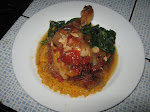
Our menu would consist of four courses, just as it does at the restaurant. We would start with a chilled curried cauliflower soup, then move to a mix of lightly dressed organic greens augmented by crunchy "ceviche" of fresh palmito (hearts of palm). The entree would be fresh local fish (to be determined by Victoriano, the fisherman) with my "soon to be legendary" Salsa de la Jungla, a spiced rice pilaf, and whichever vegetables my organic farmers told me were the best. I offered a chocolate cake for dessert, but Sharon opted for mandarina pound cake topped with blackberry ice cream.

I put together my prep and purchase list on Monday, called in my produce orders, visited Victoriano to make sure he would be coming in with fresh fish and made ready. On Tuesday I went down to the little Feria that Citrus restaurant hosts in Ojochal and met with Mauren and Ademar, good friends and organic farmers. I came away with just picked whole heads of organic lettuce, fat/ripe tomatoes, small tight heads of sweet smelling broccoli and shiny red bell peppers.

Just across the main highway and down the rutted dirt road was Victoriano's fish stand and tiny home. There is no sign, just his raised concrete platform and his two ancient coolers indicating that someone might just sell fish here. We greeted each other warmly and I was given the customary kiss on the cheek by his buxom wife, Maria, whom he calls, with all the affection and love in the world, "Gorda". The lid to the cooler was thrown open, and there, glistening in among the chunks of crushed ice were eight, nine, maybe ten gorgeous silvery yellow Robalo, bright eyed and fat, each weighing at least 5-6 kilos.

Robalo (called snook in the US), is an estuary fish. It lives between the fresh and salt waters and the meat is pearly white, beautifully lean and mild. It lends itself very nicely to sauces and has just a touch of freshwater sweetness. I chose a six kilo fish, wanting to assure myself eight beautiful cuts. I have to figure on a 50% yield when I buy whole fish and need to do my math to make sure I get what I need. Victoriano packed it into one bag, packed that one into a bag of ice and I stowed it in the trunk for the short drive to La Cusinga.

I had the produce, I had the fish and I had brought the olive oils and herbs. That left me just a few short hours in the kitchen at La Cusinga to finish my prepping. I cleaned the stems from the beautiful mix of braising greens that my friends at Diamante Farms had brought me and picked the ends from the dark green "media metre" Chinese long beans that they grow as well. Bolivar from Diamante had chopped and cleaned a kilo of palmito for me and all that remained was to slice it thin and toss it with lime juice and olive oil, roasted red peppers and garlic chives. A few grinds of black pepper and a pinch of sea salt and it was packed up and ready.

The last thing I had to do was butcher the fish; the firm, fresh robalo. I marveled at how easy it was to work through the flesh is as I slid the knife down the spine and peeled the filets away from the bone. The filet knife slid again, between flesh and skin, leaving the whole filets ready to portion. I cut thick white steaks from the filets and packed them in a double wrap of plastic before putting them on the ice in my cooler.

The bags of produce, the ice chest with soup and ice cream, the fish on ice; it was all in the car and ready to go. I took a last look around, checklist in hand, and was soon behind the wheel and down the driveway at La Cusinga, on my way to Ojochal to cook some dinner.

So it was that I found myself in Sharon and Mac's kitchen, putting a light smoky glaze on her cloth napkins and kitchen towels and searching for the cutting boards. And it all came together quite nicely. I've done a lot of catering and it all comes down to preparation (back to the "mis en place is God" philosophy, for those of you who read that blog). I was well prepped and had left myself little to do but the actual cooking.

I made the rice, set up the fish to cook and when the guests arrived we were underway. Sharon had provided me with an interesting mix of two kinds of china and it was great fun to use different plates. The guests were charming and receptive; hungry and appreciative. The cooking and service flowed and the night passed smoothly and successfully. The oohs and aahs were deeply appreciated and it seemed that just because of the reason for each of us being there, there was a common feeling of sharing and unity.

At the end of the evening, as the envelope was passed, there was a moment that drew us all nearer. We were equals, chef and diners and it was clear that I was part of this and never considered "the help". The common denominator of each of us doing something for Ben was the glue that held us together.

It is unfortunate that sometimes it takes a tragedy, such as the one that befell Ben, to pull a community together. I hope it's not too naive of me to wish that we could feel that sense of sharing life and pain along with love and happiness without needing a common cause, but I suppose I do feel that way. At least for this small moment in time, however, because of what happened to Ben Vaughn, our coastal community is closer than I've ever experienced it being.
I do hope it stays this way.


Friday, June 11, 2010


MANGOES, I FINALLY GET MANGOES

This is my submission for the July issue of Dominical Days; read it here first.

MANGOES, FINALLY I GET MANGOES

This has been the breakout year for me with mangoes. I always liked them, but didn’t love them. I’d liked using them in my kitchen, but didn’t really understand the possibilities they presented to me. I knew that they were a richly flavored and almost sexual fruit, but I just hadn’t gotten there with them, so to speak. And lastly, I just couldn’t figure out how to cut the damn things.

This mango season that has all changed. Maybe it was that I became more committed to working with local ingredients and knew that they were an essential part of a tropical kitchen repertoire. Maybe it was the smell of them in my car on a warm day as their honeyed juices warmed, and maybe it was licking my fingers after cutting them for my “Salsa de la Jungla” and discovering that each mango had a slightly different yet equally powerfully seductive flavor.

This is the year that I discovered a “signature” sauce based on mangoes. This is the year I made mango vinegar, numerous mango salsas, mango-mustard glaze and mango-coco ice cream. I found that the mango could stand up to the acid of mandarina, the bite of ginger, the heat of habaneros and the sinus opening blast of hot mustard.

I have paired mango this year with chicken, fish and pork. Each of those meats picks something up from the inherent mango sweetness and if they are cooked on the grill, they give something back with the flavor of smoke and charcoal. A crusty pork loin or crisp skinned chicken thigh brushed with a mango glaze and then pulled from the grill is barbecued poetry.

The season is almost over but there are still sticky sweet mangoes at the Feria. Buy and use them now or puree the flesh and use it later. But however you use them, don’t forget to lick your fingers.


MANGOES AND WHAT TO DO

So now, with any luck, I’ve made you want to run out and grab a few mangoes, and in an “end of the season” burst of creativity, have your way with them. I buy them with three criteria in mind; feel, smell and color. I want my mango to have some give to it when I squeeze it, but not just in one soft place. I want the smell to be aromatic and sweet. And I want the color to be a lovely hue of red running into gold over the entire fruit.

Cut off enough of either end so that it will stand up on its own. Using a paring knife, from top to bottom take the skin off in long narrow strips. When the peel is gone, stand the mango up again and look at it from the top. It should be ovate, rather than round. The longest sides of the oval are where the greatest amount of the flesh is. Using the blade of the knife, find the seed and slide the knife downward, staying as close to the seed as possible. The flesh should come away in a long even piece. Continue around the mango, working the knife down the pit. You will have two larger pieces of mango and several other long narrow pieces. You are ready to cook.

MANGO MUSTARD GLAZE

Flesh of One Ripe Mango

Juice of 2 Mandarinas

½ Cup Orange Juice

½ Cup Tapa Dulce, or Brown Sugar

1 tsp grated fresh ginger

2 TBS Dijon Mustard

In a stainless or non-corrosive pot, put all the ingredients except the mustard. Bring up the heat to a low boil and then reduce the heat and simmer for 30 minutes, stirring to break up the pieces. Remove from heat and stir in the mustard. Use as a glaze for pork, chicken or fish. Use it now, or chill and reserve.

Friday, June 4, 2010

THE TIMES THEY HAVE CHANGED


So here I am, sitting on a bar stool in front of the granite counter tops at the "house up the hill" using the internet. "How does he do it?", you may or may not ask. We know there is no internet service way up there on the hill.

Well, the story goes like this:
I was sitting in the Uvita Tucan Hotel (not listening to the airconditioner hum), using the internet before I headed home for the night and I ran into Big Rob, who used to do (poorly) the internet at La Cusinga. I confided in him that I had been looking for an internet device, kind of a "memory stick", which, when stuck into one's computer, accesses internet. These do indeed exist, and they even exist here, but trying to find one for purchase has proved difficult. "Just ran out", or, "new supply next week (month, year, etc.)" are the standard answers.

So he listened to me bemoan my fate and then asked me what kind of phone I had. Costa Rica is in the process of changing over from 2G to 3G phones, which will fuck up their entire phone service system, but they don't seem to care. I told him that I had a 2G as they still worked (for now) and were significantly less expensive that the 3G models which all seem to feature numerous application possibilities; bells and whistles out the wazoo, if you will. So he says, "well that's too bad" and goes on to explain to me that if I have a 3G phone, it can be converted into a modem that will transfer internet to any computer it is tethered to.

"Whoopee", I say, averring as to how I certainly wish I had one, but that they were entirely out of my price range. "But oho" he says, "I happen to have one for sale". And so he proceeds to tell me that he had purchased this here top of the line Nokia 3G but now an iPhone has fallen into his chubby little hands and that he cannot/will not live without it, thus rendering the Nokia obsolete in his squinty eyes.

So to make a long story endless, I bought the Nokia from him for $100, figuring, if nothing else, I now had a groovy phone way cheap as the damn things retail here in Costa Rica for over $400. But lo and behold, I take it down to ICE, the utilities conglomerate that essentially runs the country, and yes, they can give me internet capability AND, better yet, make my new phone and my old laptop compatible. Shit boy Howdy.
So I sit in the chair in the brutally air conditioned ICE office (everyone who works there wears a jacket) for over an hour and a half while the Tico tech with a truly interestingly gelled non-hairdo puzzles and putzes over my two electric boxes. I meditated, I sang to myself, I listened to the air conditioner hum and out of nowhere his somewhat greasy face breaks into a wide grin as if he has opened the diamond vaults atAntwerp. Entonces and Voila! He has broken the code and he is going to share it with me.

And so, I know have the internet here at the "house on the hill" and I'm pretty damn happy about it. It does suck the charge out of the phone pretty damn fast, but if one pays attention it is a non-issue. Wondrous times in which we live.

Wednesday, May 19, 2010

CHEF'S SECRETS, PART 2, OR, FLAVOR AND WHERE HE GETS IT

CHEF'S SECRETS, PART 2
or,
FLAVOR, AND WHERE HE GETS IT

DRY INGREDIENTS

I have two storage stashes for my flavor boosting ingredients, cold and not cold. The supplies that are dry and mostly non-perishable go in the pantry or on the kitchen shelves. A few of them even reside close by the stove. Most of these are things you can buy at the store and you probably keep a few of them around in your own kitchen. Do NOT underestimate the value of these seemingly mundane items.

First and foremost is salt. And not table salt, but yes, I keep that around too; mostly for salting the water of things I blanch or par-cook. I cook with kosher salt and I use sea salt when I want that Bang-Pow salt effect in a particular dish. But back to your table salt for a moment or two. Do you blanch vegetables like green beans or broccoli or carrots until they're just done and then saute them in butter or olive oil just before serving. No? Well I do and they taste better for it.

And they taste better still if you put a heavy dose of salt into your blanching water. In Thomas Keller's world famous restaurants, French Laundry (Napa Valley) and Per Se (Manhattan) he instructs his cooks to blanch their green vegetables in water "as salty as the ocean". Why? Because it brings out FLAVOR.

Next to the salt on the shelf is black pepper and no, not black pepper that you buy pre-ground in a little plastic package or a jar. I use either a pepper grinder in the kitchen or if I am really busy, I pre-grind black peppercorns in a coffee/spice grinder each day and keep them in a cup near the stove. Black pepper is one of the simplest flavor boosters I use, but I never tire of the "bump" it gives to salads, fresh sauteed vegetables, or meat and fish. And if you really want the pepper to have some zing (this is a secret, don't tell) toast the whole peppercorns really lightly in a skillet until the start to give off a peppery scent and then grind them. Zap.

Okay, moving on through the dry goods. I always keep a good (and relatively fresh) bag of red chile flakes around to add little bursts of heat to pasta sauces (specifically tomato). You can buy bulk red chile flakes at places like Whole Foods (gak!) and you can be reasonably sure that they have sufficient turnover so that the chiles are not aged into a second dehydration. Another spice blend that I keep around is packaged curry powder. I use it in a couple of my soups and I slip it into flour mixes that I use for fish or chicken before pan-frying. It is also a principal ingredient in my Chilled Curried Cauliflower Soup. Again, this is not one of those things that you want to try to use after it's been sitting on the back of your pantry shelf for two or three years

Something restaurants have been using for many years (I first started using it at the Elite Cafe in the mid-90's) is Pimenton, or smoked paprika. It has been hard to find, but now commercial spice manufacturers like McCormick are selling it. Paprika is made in Spain and Hungary by drying pimiento chiles (a long sweet/hot red pepper) and grinding it. Most of the commercial paprika on shelves in people's home kitchens is so old it is no longer hot and not even perceptibly sweet. This, like the chile flakes, is something best bought from a wholesale spice seller and used soon after purchase. But, back to the Pimenton, which is those same pimiento chiles, but smoked before being dried and ground. The flavor difference between regular paprika and Pimenton is profound and I love to use it in rice dishes like jambalaya, braised chicken dishes that use roasted tomatoes, any stew I make that includes sausage or pork products and soups. This is a very interesting flavor and I can't recommend it highly enough.


Something I just recently started keeping around and working with is tubs of different flavors of Thai curry pastes. They generally come in red, yellow, green, and massaman. They represent a lot of hard work avoided, if one tries to make them oneself. as is asked for in a number of Thai cookbooks and recipes. Essentially, they are a paste made from fresh and dried chiles, ginger, a number of different dried spices (turmeric, cumin, etc.) and they pack a flavor wallop. I use them in rice, sauteed vegetables and in a couple of the cold soups that I make. I particularly like the flavor boost that a tablespoon or so of Thai curry paste gives to my carrot/beet/ginger soup. But use them judiciously, as a little bit of these goes quite a long way. And yes, they are hot!

The Ticos use a lot of achiote paste to color rice and vegetable mixes and I must admit, I'm not adverse to stirring a spoon or two of it into the vegetables I saute when I make a batch of rice pilaf and I want some color (bright, bright yellow, indeed) from it. Achiote paste is made from grinding annato seeds which used to be used in an old kitchen staple from the 50's and 60's, "Egg Shade", used in shrimp and fritter batters. There isn't a significant flavor in achiote, at least none that I can detect, but it sure does make rice a lovely shade of yellow.

And lastly, one of my secret ingredients is a quasi-Cajun spice blend. I've worked in two restaurants that were New Orleans-oriented and saw my share of blackening spices. If I never see blackened redfish again, it will be too soon. But I still love to use a blend of paprika, cayenne, dried thyme, salt, and black pepper as a seasoning agent. I use it in rice. I use it in flour mixes for frying. I add a healthy whack of it into the sauteed vegetable base I add into my seafood or crab cakes. The cayenne provides heat, yes, but the subtlety of the paprika carries a lot of flavor. And it definitely needs salt to help distribute all the flavors. You certainly can rub it on fish or chicken before you pan-fry it and it works nicely with anything you're about to put on the grill, as well. It will burn and char a bit, but I suppose that's the point of blackened anything. My blend used eight parts paprika, one part cayenne, four parts of salt, two parts black pepper and one part dried thyme. Occasionally I will put mustard powder into it if I'm feeling "that way" and crumbled bay leaves are nice if you're not coating fish or meat with it.

I use dried thyme when I make chicken stock (it is irreplaceable) and beans. Bay leaves go into almost all stocks and long cooked braises. Almost all other dried herbs are a waste of time. Oh go ahead and keep some dried oregano around, as long as it's relatively new to your spice cabinet. Take any of your dried herbs that are over six months old and throw them away.

WET INGREDIENTS

Oil and vinegar; wet ingredients. And there you have it, but for the fact that there are so many misconceptions about oils, particularly the various kinds of olive oils, and the fact that balsamic vinegar is just so great in everything. Not.

I use one basic oil for cooking; a canola oil blend. I can get it all the way up to smoking hot and it doesn't burn. It it great for pan-frying fish and chicken and I use it frequently. I generally use it once and toss it. Fish cooked in twice used oil is nasty but occasionally you can get away with it for chicken if you strain it right after you use it and keep it in the refrigerator. I also use half canola oil and half olive oil in a lot of my salad dressings and definitely in mayonnaise. The one great thing it has going for it other than a high smoke point is that it has virtually no flavor. And here's where we segue way in to my olive oil rant...

Despite what they may tell you in cookbooks and on those damn cooking shows, you DO NOT NEED to use 100% olive oil in your salad dressings. Good olive oils have enough flavor to overwhelm the most acidic and saltiest of salad dressings. You can save money and taste the other ingredients in your dressings, aiolis and mayonnaises if you use equal parts olive oil and canola oil. Buying a "light" olive oil is a waste of time. Buy good olive oil and mix it. And if you absolutely must cook with olive oil (don't do it, don't do it), buy the damn light stuff. Good olive oil is not for cooking. Period.

I was talking the other day with an old friend (who shall remain nameless) about a recent recipe for mayonnaise that I had posted on this blog and he said, "So I should use extra-virgin olive oil, right? It's the best, isn't it?" Well yes and no. As far as being the best, it's the purest and has the most flavor. Does that make it the best? Everything has its use and you do not use extra-virgin olive oil except for flavor. If you want to put a splash of it in a dressing at the end of making it that's fine and if you'd rather drizzle it into your salad just before tossing, that's better yet. Most high quality extra-virgin olive oils are flavoring agents. They are not for cooking and they will overwhelm any sauce you make with them in which they are the sole oil used.

Please, please, don't misunderstand me. I love, love, love good extra-virgin olive oil. I love the way a tiny bit of it tastes over a piece of hot grilled fish, mixed with a squeeze of lemon. I love the way it tastes when you drizzle it over lovely fresh tomatoes. And I really love it on fresh grilled bread of high quality. Yes, indeed. I do not love it heated too hot and I do not love it when it overwhelms an otherwise delicate sauce.

And that brings us to vinegars. I love vinegars, too. Acid, used correctly, works much like salt in bringing out flavors. This is why we squeeze lemon over our fish and this is why we put vinegar in salad dressings. Years ago when I worked with Mark Miller in Berkeley he taught me a huge lesson by pouring a good splash of high quality red wine vinegar into a soup to finish it, rather than salting it; brought the flavors right up and helped to balance everything. I liked that.

As you may have inferred I am not a huge fan of balsamic vinegar. Most commercial balsamic vinegars have sugar and artificial coloring added to regular vinegar and are a "safety flavor"; mild and inoffensive so that people with timid palates can use them with impunity. Frankly, that's not me. I use commercial balsamic vinegar to pack roasted beets in and to braise red onions. I also toss fresh strawberries with balsamic vinegar and tapa dulce, our local cane sugar, to spoon over a Basque almond torte I make. For my palate, there is not enough acid in balsamic vinegar for it to make a decent salad dressing. There are many grades of expensive balsamic vinegars and much like extra-virgin olive oils, they are "finishing vinegars", best used as a final drizzle of flavor over tomatoes or even roasted meats.

My favorite vinegar for dressings and hits of flavor is Sherry Vinegar, or Xeres, if you're buying it in Europe or Costa Rica. It has a nice acidic bite without making your nose tingle and doing that funny thing down your eustacean tubes, and there is a "woodiness" to the flavor of it that blends well with most everything. I use it frequently, along with olive oil, sea salt and fresh ground pepper to marinate tomatoes for salads. I use sherry vinegar mixed with a bit of commercial red wine vinegar in salad dressings and have even used it to deglaze the pan after I have roasted chicken breasts.

There are a number of flavored vinegars on the market and they all have their uses. For a white vinegar I like champagne vinegars, as they seem to have a bit of fruit to them, unlike a simple white vinegar. I do keep white vinegar in my kitchen for making "chilero", the famous Costa Rica hot sauce that uses habaneros. Vinegars are a great vehicle for carrying heat which is why Tabasco ferments its chiles in vinegar and vinegar only. I do keep a good quality red wine vinegar on the shelf as it goes into my Caesar salad dressing in equal parts with lemon juice. If you are buying red or white vinegars here in Costa Rica make certain you are not buying something that mentions the word "artificial" on the label. Chemical acids are used here to create vinegars and there is virtually no real flavor in them. Cuidado!

So get in the kitchen and cook with flavor! Mild is not a word in our vocabulary.
Aspiring to mild flavors is like aspiring to senility. Create your own flavor profiles using any or all of these ingredients and remember, Food Is Love.

Saturday, May 15, 2010

ALTAMONT; THE CONCERT

This is a piece I wrote for a new Facebook page a friend of mine, rock photographer Jim Wiseman, put up called Altamont the Concert: An Oral and Visual History. He and I had been discussing this via Facebook chat and he invited me to share my recollections of that horrifying day. This is sort of born out of a new book by former Stones and Grateful Dead manager Sam Cutler who wrote a bio of his times with the two bands. A rather chilling photo of him onstage with Mick Jagger and a host of Hell's Angels got us talking. I wrote down what I remembered, what I saw and what I thought I remembered. Someone who knows me well says it may be my best piece of writing, yet. I'd love to hear your comments.

Altamont Stories
Share

Altamont Stories
Share
Share your Stories here:

I

T

Saturday, May 1, 2010

CHEF DAVE'S SECRETS, or, FLAVOR AND WHERE HE GETS IT

CHEF DAVE'S SECRETS, PART 1
or,
FLAVOR, AND WHERE HE GETS IT

I know, I know, this is the part where a momentary hush falls over the room and they ask themselves, "Well, does he really know anything and is he really going to share any of it."
What I may or may not know is certainly debatable and it is ultimately true that one man's knowledge may seem like embarrassing ignorance or pure bull to others. That being said (an entirely over-used phrase), what I will do is let you on to a few tricks that I use, ingredients that I keep around and ways to combine them to help bring out flavor in dishes that might need a little boost in the yummy department.

I'll get to my opinions about what you have in your pantry and on your shelf in a while, but this first part of my diatribe will talk about the things I keep in my refrigerator as flavor enhancers, or boosters, if you will. These are little pots and potions that are easy to prepare in advance and that can lend that little bump of flavor to dishes that might otherwise be just good as opposed to "over the top".

In the lower part of the refigerator, not the freezer zone, I am never without a jar of roasted garlic cloves in olive oil, marinated roasted red pepper strips, homemade mayonnaise and chicken fat. Each of these things will lend flavor in its own unique way; the garlic and peppers for sauces, dressings and salads: the mayo for fish sauces and dressings and the chicken fat for adding a little subtle flavor to anything that you may wish to saute.

Roasted garlic cloves are a simple prep. Just immerse them, peeled, in olive oil (make sure they're covered) and cook them on a very low heat until they are meltingly tender. Keep coming back and checking your flame on these, as it will want to jump up and boil them. You don't want that happening; really. And once they have cooled in their oil, you can jar it all, cloves and lovely garlic scented oil. The oil is for salad dressing, cooking vegetables or even adding to emulsions like mayonnaise (more on that in a moment). And the suave and creamy garlic cloves can be spread on bread or crostini, pureed and used to thicken sauces, added to dressings and so, so much more.

The roasted red peppers are another multi-use flavor enhancer. These require a bit more work and attention than the garlic, but you will happy that you've put in the time once you start to use them. The best way to roast red peppers is over the open flame of the burner on a gas stove. I put three or four around the burner, cranked to full and keep turning them with my trusty tongs until they are charred on all sides. And yes, they will get black but don't worry, that part comes off soon. As the peppers become completely blackened, put them in a bowl or plastic container that has a tight fitting lid and shut off the air from reaching them. You can also put them in a plastic bag, but be careful they are not so hot as to burn through it. The idea is to allow the steam from the cooked pepper to lift the burned skin away from it so it can be easily removed. And to remove it, let the peppers cool, peel away as much of the skin as you can and remove the rest under running water. Yes, your hands will get dirty, but you'll thank me for this later.

Once the peppers are peeled, split one side of them with a knife and remove the seeds by just pinching them out. Rinse the peppers again to get out all the seeds and pat them dry. Cut the peppers open; down the side you split to get the seeds out and lay them on a cutting board. Cut them in thirds and then into thin strips. Put the strips in a bowl and add salt and pepper, a little vinegar (I use red or sherry) and mix well. Put the strips into a glass jar that has a lid, or one of those zip-loc containers with snap on lid and pour in enough of the garlic oil that you've just made (or just regular olive oil) so that the peppers are covered. Put the lid on tight, shake well and refrigerate for a day or two to get the flavors to mingle. And mingle they will.

Both the roasted garlic and roasted red peppers are used in salads and sauces and a great many of the sauces are based on that staple of professional kitchens (and yours too, since it's easy), chicken stock. We'll get into chicken stock; how and why you should make it, and all the things you can do with it further on, but for now we're dealing with little flavor boosters from the fridge and one I use frequently, again, with help from the chicken, is rendered chicken fat.

Every time you buy a whole chicken and look up its posterior you will see a clump of yellow-y fat attached to either side of said orifice. Most of you (an often) me, would have thrown these out in a previous life, but don't do it; don't do it! Instead yank it out and put it somewhere safe; a bowl, a plastic container, somewhere. Additionally, as you break down your chicken into smaller pieces, you will encounter more fat and a lot of pieces of skin that you won't want to cook. Cut all of these off and save them too. When you have a nice pile of chicken fat and skin, put it into a small heavy pot with a couple of tablespoons of water, put it over a low flame and cook it slowly. The fat will render, the skin will become crisp and you will get, after perhaps an hour or so, a nice coppery colored clear fat surrounding your chicken cracklings. Pour it through a fine strainer and save it. Eat the cracklings if you like; over a salad, by themselves, or not. I give mine to the dog.

But the rendered chicken fat, the chicken fat; prized in Jewish cooking as schmaltz, will add flavor to anything and everything you cook in it. At my restaurant, Belle Roux, in San Francisco, my cooks and I, as an experiment, saved and rendered all the fat and skin from all the chickens we cut (and we were banging through a couple of cases of 24 a week). We started using it for sauteeing and cooking whatever we put on the griddle and not only did we save a lot of money, but we discovered that catfish in a spicy batter tastes really good cooked on griddle in chicken fat. But, I digress, this about you, not me. At your house, you can use the chicken fat for anything you would use ordinary cooking oil for. If it is rendered properly and strained through a fine mesh strainer, it can be heated to a relatively high heat. And it makes green beans, spinach, and anything you pan-cook taste better. I would hesitate, however, to use it for pancakes.

And lastly, in this section, before we get to the goodies in the freezer that are equally important in building and boosting flavor, we come to good old mayonnaise. There is no comparison between store bought mayo (even if you swear by Hellman's or Best Foods, west of the Rockies), and what you can make in three minutes with your food processor. Store bought mayonnaise has so much sugar and so many stabilizers (for shelf life) in it that you can't taste what it's really made of; eggs, good oil, dijon mustard and a hit of vinegar and/or citrus.

Check this out:
Put 1 Egg and 1 Egg Yolk in your food processor.
Squeeze in the juice of one big or two small lemons (no seeds, please);
A splash of good vinegar (and for God's sake, Balsamic is not good vinegar),
Two crushed garlic cloves;
1 TBS Dijon Mustard;
pinch of salt and three or four grinds of pepper;
a dash or two of Tabasco.

Pulse all this in the processor until combined and then (slowly, but not painfully slowly) drizzle in 1 Cup of Canola (or other cheap kitchen oil) and 1 Cup decent but not Extra Virgin Olive Oil. You can also substitute some of your roasted garlic oil here if you want a gentle garlic flavor in your mayonnaise,
As you are adding the oils, about halfway through you will hear a change in the sound the motor of your food processor makes and that is the sound of mayonnaise being made. When the oils are completely added, take off the top and take a scoop with your finger. That's what real mayonnaise tastes like. If you like more salt or more acid (lemon or vinegar), add them. If the mayo seems a bit too thick for you, add a bit of warm water with the motor running.

Voila! Fresh real mayonnaise to use in the best tuna or potato salads, in salad dressings, to add to dips for crudites, sauces for fish (it makes a killer tartar sauce with the addition of chopped capers and green onions), particularly with artichokes, or whatever you like. If you keep your new mayonnaise buddy cold he will keep for up to two weeks in your refrigerator. Use him frequently; become both friends and allies.

So there you are; four easy additions to your arsenal of flavor boosters. And believe me, I use these four ingredients on an almost daily basis. Next up, we'll move to the freezer for a few more tools from my box and tricks from my bag. Chow for now. chefdave

Wednesday May 13, 2009 La Cusinga and Me


This words below are from our website describing La Cusinga.  The story, however is much deeper and much richer than these introductory words can describe.  La Cusinga represents a noble and successful effort to preserve this section of unspoiled coast and to keep it alive as a model of what true ecology can accomplish.  The dreams and visions of John Tresemer, the owner of La Cusinga and the Finca Tres Hermanas that surrounds it, have been realized here in what is a true example for all who would preserve and protect what remains of this, or any natural wonder. 

La Cusinga 
La Cusinga Lodge is a coastal rainforest eco lodge dedicated to marine and terrestrial conservation and environmental education. Its location on the southern Pacific coast provides guests with sweeping ocean views and a relaxing beach vacation. In addition La Cusinga is part of a private nature reserve that supplies the visitor with an unparalleled look at Costa Rican wildlife and rainforest. The reserve consists primarily of 250 hectares of virgin rainforest that borders thousands of more acres of privately protected forest. On Costa Rica’s still wild south-western Pacific coast, La Cusinga Lodge borders Ballena Marine National Park which was developed to protect the humpback whales that frequent the coast. La Cusinga Lodge was established in order to share the unique site with Costa Ricans as well as international visitors. Besides getting exposure to rural Costa Rican culture and beautiful vistas, visitors have access to highly prolific areas of primary tropical rainforest and unspoiled coast, all conveniently accessible. 

i returned to La Cusinga this past January, 2009, with a dream in mind.  I wanted to create a cuisine for our guests that would bridge the gap between what La Cusinga offered physically and spiritually, and what they were putting in their bodies when they ate here.  I knew from having previously lived in Costa Rica for over two years that there were organic farmers and that sustainable agriculture was being practiced, but at that time it had been limited in its scope as well as its distribution.  

My first steps upon returning were toward the local Feria to seek out and communicate my ideas with the growers and vendors who could provide me with a local, organic and sustainable product.  The fertile valleys of San Isidro that lie over the coastal mountains and to the Northeast of our Pacific location are rich and productive but are only now exploring the potential that they hold.  

I had in mind a vision that would support local farmers, fishermen and food artisans and one that would recreate (or perhaps, create) a new cuisine of Coastal Costa Rica.  I visit the markets each week to talk with growers and to develop the  relationships that I believe will be mutually beneficial as Costa Rica experiences its rapid growth on an international level
.
Organic farming is a new and not heavily supported concept in our part of Costa Rica.  It is a brave step for farmers to make, as local communities of both growers and consumers have never placed, or not known to place, an importance on farming organically and sustainably.  I feel a responsibility as a Chef here to be at the forefront of those encouraging and supporting these pioneers  

I came to La Cusinga almost three years ago not knowing what to expect.  My first time through here was characterized by a lack of understanding and appreciation on my part as well as an inability to recognize or connect with the local "flavor" that would make for a coherent package for out guests.  I now feel as if I have made a "connect" with the property and the vision.  I am not completely satisfied and hopefully, never will be, until we are able to produce, right here at La Cusinga, the greater share of the produce we serve.  However, the groundwork has been laid with local farmers and the availability and quality of organic produce is impressive.

Now at La Cusinga I serve a variety of organic lettuces and braising greens.  My salads include wedges or slices of rich red tomatoes as well as sweet !00 and yellow pear cherry tomatoes.  I roast organic beets and marinate them in balsamic vinegar to be served alongside the lettuces and topped with a locally made organic goat cheese.

My soups are made from roasted and steamed local organic vegetables and tiny organic yellow creamer potatoes have found their way onto my plates, nestled against filets of locally caught fish.
I am now using a local organic cocoa powder that still contains the nuggets of cocoa butter unlike the fined cocoa powder in the markets.

And better still, I am able to use palmito (hearts of palm), ginger, cilantro and its sawtooth leafed cousin culantro coyote, mangoes, hot and sweet chiles, mandarina limes and yucca root from our own Finca Tres Hermanas to serve in my dining room at La Cusinga.   The connection from jungle and farm to table is evolving.  May it continue to grow.