Thursday, September 23, 2010
TRAVELING CHEF, Part 2
Wednesday, September 22, 2010
Traveling Chef
Sunday, August 29, 2010
lT'S ALL lN THE PANTS
Last night at dinner l approached the table of some guests (friends of mine as it turned out) to ask them, as is typical for me, how everything was. Fortunately, the food was good and they were happy, but then my friend John pointed to my chalk-striped black chef shorts and said, laughing, "And do those shorts make the food taste better?"
l was caught a bit by surprise, something that happens to me much more often in places other than my own dining room, but recovered quickly enough to show him the "Chefwear" logo that appears on the right front pocket of these and any other pants made by Chefwear. This is hardly a plug for Chefwear, or Kitchen Collection, or even Birkenstock, for that matter, all of whose products l wear to cook in, but more an expression of wonderment that people are amused that those of us in my industry have our own work clothes.
We laughed about it at John's table and then he pointed to the fork logo on the brand tag of my shirt and we laughed again. l made a joke about how unprofessional it would appear for me to be cooking in my own clothes, or perhaps, board shorts and a raggedy T-shirt, and how that might create somewhat of a mistrust of the seriousness of my mission; we all shared a chuckle and they went back to eating.
A couple of days before that, my girlfriend, upon seeing another pair of striped chef's shorts, had remarked that l looked like l should be refereeing a soccer match. And just a day or two before that l had been in a meeting when the person next to me, seeing the Chefwear logo on my shorts had burst into laughter and then said, "Oh, how cute, Chefwear, did someone make those for you?" l wandered back into my kitchen, after answering John, but the question plagued my mind as to why it would seem so odd and/or humorous to people that we kitchen workers would have clothing specific to our industry.
Forty years ago, when l first got serious about cooking, one was asked one's jacket size and pants size upon taking a new job. This was because restaurants used to supply their cooks with the work clothes of the trade. A linen company would deliver, along with the tablecloths and napkins, racks of cook's clothing, on hangers, and separated by size; checked pants and white starched double breasted jackets. A lot of them even stenciled your name on the sizing label on the outside of the pants pocket. Yes, really.
Was l ever grateful to find that out. Previously l had worked for steak houses that gave you a logo shirt and you wore your own pants. And by the end of the shift your favorite or even less than favorite Levis were coated with a layer of grease, and by the end of two or three days they were no longer your favorite Levis. Now, in my new attire, no matter how greasy l got, at the end of my shift l could drop my dirty clothes into a linen hamper and forget about them. Yes, l still had to slide my greasy smelly body into my own clothes for the remainder of my day, but at least l hadn't worked in them. l wore shorts home a lot and some of the cooks would simply wear the next shift's pants home and back in the next day.
Naturally their were glitches; days when l wore someone else's chef's coat, snatched furtively from a hanger, and days when l wore pants that were either impossible to bend over in, or were cuffed three times at my ankles. But still, the "mud and the blood and the beer" as we used to say, were absorbed by someone else's clothes. And l liked that a lot.
Somewhere along the line, probably as early as the late 70's, but to the public's perception, more like the early to mid-80's, restaurants began to change. People's ideas about restaurants and food began to change as well. And accordingly the people working in restaurants began to change. For one thing, someone who pursued a career in the food industry was no longer consider a pariah, or a certified loser, as had been the case in my early days.
The older men l'd worked with, the ones with military kitchen and country club backgrounds; the ones who'd looked at me in derision at my lack of experience, were now gone; retired, moved along to the next place or dead. The restaurant "lifers", among whom l now considered myself, were disappearing. Dinosaurs, my few remaining cohorts and l called ourselves.
A newer type of cook was emerging. For some reason working in a restaurant became "hip" and leaving one's graduate studies to become a cook/chef was not at all unheard of. And these new cooks didn't take at all to the old style industrial looking cook's clothes. l started seeing a whole lot of my new kitchen mates coming to work in and then working in their jeans.
And much to my dismay, once restaurants saw this, they began, in a cost cutting effort, to stop supplying their cooks with the black and white houndstooth checks of my youth. They couldn't get away with discontinuing the jackets, as the starched white look was too classic, but the pants were fast disappearing. And in their place were the jeans and cords that the cooks would come to work in (it was a good thing more than a few pair of cooks checks had made it home with me).
But something new was happening and l'll have my hand shoved in a hot french fryer if l can remember when it began, but suddenly baggy chef's pants with elastic waistbands began showing up in kitchens. lt seems that a woman named Rochelle Huppin (of course, it had to be a woman) had not liked the old stodgy and starchy uniform she'd been issued at the Culinary lnstitute of America (and damn, they even had cooking Academys now) and had designed and sewn her own pants.
As if overnight, Rochelle's pants (so to speak) were in every kitchen in America that mattered. They were comfortable, they were cool, in more ways that one and they pushed the envelope of design and color. Yes, the came in the same old houndstooth, but NOBODY wore those. They also came in solids, wild and colorful patterns with food themes, and they came in stripes. Every kitchen had two, three, four cooks sporting different and wildly colorful pants.
America had a new industry. Sales of cookware, expensive knives and cookbooks soared. Chefwear spawned a wide array of imitators, some good, some bad, but as near as l can tell, most still in business. Chef's were on TV wearing logo wear. Housewives could suddenly quote Bobby Flay recipes and had monogrammed chef's jackets hanging in their kitchens next to their All Clad pan sets.
So this is in part why Chef Dave is in the jungle wearing striped Chef Wear kitchen shorts. Consider them the Carhardt or Ben Davis of my profession and please remember, best of all, l don't have to cook in my street clothes.
Tuesday, August 24, 2010
SAD NEWS/BAD NEWS
Tuesday, August 10, 2010
CHlCKEN POOP/LEG MAN
These are my newest articles for the September issue of Dominical Days
CHICKEN POOP
I’m going to share a secret with you. You can get chicken here in Costa Rica that has flavor. Yes, you can buy chicken that is not laced with hormones and chemicals, too. You just have to know where to go, and I’m here to tell you.
There are two companies that have a stranglehold on the poultry business in Costa Rica and I’m sure you, like me, have at one time or another found yourself behind one of their trucks touting the freshness of their poor tortured chickens. Those chickens may have, at some time in their miserable lives been fresh, but by the time they reach you, they are all cottony flavorless breast meat and scrawny legs and thighs.
Chickens that are mass produced to meet the demand of a busy market are forcefed and hormone primed so that the can be rushed to you in just over three weeks. This is so unnatural as to be horrifying.
A happy, grainfed chicken should take somewhere between six and eight weeks to reach a size suitable for cooking and also to develop a flavor and firmness brought on by not being penned. This is not nearly fast enough for a busy chicken “production plant” that is more concerned with stocking freezers than producing good-tasting healthy chickens.
Fortunately for those of us who are passionate about serving quality ingredients to our families and friends I have found a source for organically raised free range chickens. I am now pre-ordering and buying beautiful healthy delicious chickens through Ademar and Mauren who are at both the Uvita and San Isidro Ferias, and so can you.
And if you don’t think I’m serious about this, I visited the two of them at their finca so I could personally witness what the chickens ate and how they lived. These birds get the Chef Dave stamp of approval for health and flavor.
LEG MAN
I am a leg man. Give me a chicken and I immediately begin to scheme on a way to serve the legs; umm, love that thigh. I used to have a girlfriend who would only eat the white meat of the chicken and it drove me crazy so I devised a cooking method that even she liked.
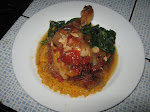
The best way to cook a chicken leg, to my thinking, is to braise it. Yes, crisp the skin, flip it over, splash in some wine and stock and pop it in the oven for about 45 minutes until it is meltingly tender. I have won over numerous “white meat only” people with this recipe. When served over mashed potatoes, risotto, or a good rice, this is tender and delicious.
Braised Chicken Legs
Preheat oven to 400
4 Full Chicken Legs (thigh and drumstick);
½ Cup Dry White or Red Wine;
1/2 Cup Chicken Stock or broth;
3 Cloves Garlic, chopped;
1 Cup Chopped Tomatoes (or better yet, home roasted tomatoes)
Salt and pepper the chicken legs, dust them with flour and crisp them in a bit of cooking oil, skin side down in a sauté pan you can put in the oven. Take them out when the skin is crisp and pour out the oil. Return the pan to the flame and add the garlic. Pour in the wine and allow to reduce by half. Add the chicken stock and bring to a boil. Add the tomatoes and the chicken legs, letting them settle into the liquid. Put the pan in the oven and cook for 45 minutes.
Remove the pan from the oven and remove the legs from the pan. Pour the liquid into something that can be easily skimmed and remove the fat from the top. To serve, return the chicken and the sauce to the pan and put them back in the oven for ten minutes.
Friday, July 30, 2010
TWO COUPLES/TWO FINCAS
I would like to use this opportunity to both appreciate and introduce you to the two couples that do the hard work that brings me the organic produce I value so highly. Mauren Jimenez and Ademar Varela, who own and run Los Coreotos, their own certified organic finca, are one couple and Marjorie Cerdes Mora and Bolivar Cortes Gomez, the operators of Diamante Organico are the other. These two couples, between them, supply me with 90% of the produce (all organic) that I put on my plates. In each family both partners share the workload, and interestingly, on both farms, the women handle the ordering, the paperwork and the bulk of the communication.
I have written here at great length about my trips over the hill and down into El Valle de San Isidro to visit the Thursday Feria in Perez Zeladon. The market there is immense and the beautiful produce is a multi-colored reflection of the bounty the valley has to offer. My visits there, however, are not of the onions and carrots, garlic and potatoes variety; the nuts and bolts of cooking, if you will. The Thursday Feria is where I hunt down the newly seasonal, the small batches and special growths, the perfectly ripe tomatoes and the handpicked watercress that screams “use me today”. I should note that there was no watercress yesterday, it was eaten by a tapir.
The real workload and major part of my tiny supply chain comes, however, from Los Coreotos and Diamante Organico.
I first met Mauren and Ademar at the Perez Feria a year and a half ago. My boss, Geinier Guzman, introduced me to them on my first day back at the market after a long absence and suggested that if I really wanted to go all organic that they were a good place to start. They had a table in the line of tables in the back corner of the football field sized platform and Mauren wore the green blouse that showed that she was selling “certified organic”. Geinier introduced me to a couple in their early 40’s who were a bit “Tico shy” at meeting a gringo, but I pulled out my somewhat rusty Spanish and we were off.
Mauren is slender with tousled curly black hair and the patient but world weary look of someone who has raised three children while partnering in a small self-sufficient farm. It appears that sleep is somewhere down the list of her priorities, but she is warm and open and we have become good friends. Ademar is the muscle, the physical part of the farming and he looks the part. He is short and strong with a dark tan, a firm grip and and ever present white straw cowboy hat perched on his head. I am so immensely grateful that we all hit it off from day one.
My buying history with Los Coreotos began with me making one buy from them at the Thursday Feria in Perez Zeladon and then another at the Saturday Feria in Uvita. At that time La Cusing was buying our "nuts and bolts" from a local non-organic vendor. I wasn't happy with that arrangement, nor the quality of his goods and I wanted a change. It became clear over time (and as our business increased) that we would need a delivery early in the week and we struggled with how to put that together. Los Coreotos is above the San Isidro Valley and it is a long trek to the coast for Ademar to service just one account.
In February of this year Mauren and Ademar courageously pooled resources with a local seafood vendor and opened a small retail outlet here in Uvita. This was great news to me, but sadly, community support was tentative at best. Signage was bad and our local gringos went on buying produce and frozen fish from far away at La Corona and the BM as they had in the past. But what this did do was open the door for Mauren and Ademar to develop a small produce distribution network here along the coast.
They say that when a door shuts a window opens, and suddenly I was able to get not only my specialty produce from Los Coroetos, but also to have them pick up and deliver the potatoes, onions, carrots and garlic that we need on an ongoing basis. Now I get three deliveries a week and we're all happy. Additionally, Mauren and Ademar have begun to participate in yet another Feria further south in Ojochal and their business is good, but not doing much for Mauren's world weary smile.
My introduction to Marjorie and Bolivar at Diamante Organico came in a much more roundabout way. Diamante is owned by Linn Aosjia, a vibrant woman with spectacular blue eyes who split her time between farms in California and the San Salvador valley, between the coast and Perez Zeladon. Ironically, I had met Linn during my riotous days at the Lookout Hotel in Ojochal and had even catered the week long party that was her wedding in Spring of 2006.
We had made phone contact and had circled each other a bit warily, as our previous relationship had had it's ups and downs. We had, however, each been through a few changes (perhaps a bit more significant on my part) and our first meeting was classically defined by her showing up at my kitchen entrance for her first delivery with the Grateful Dead singing "when life looks like easy street, there is danger at your door" from my iTunes. We had a good laugh about the irony of that and the ice was broken. And better yet, the produce she brought me was nothing short of awesome, a word I use infrequently.
Everything she pulled from its bag that first visit was of exemplary quality. I had asked her to bring me a sampling of greens to braise, one of my passions, and the bag she brought had not just three or four, but nine different varieties, beautifully mixed. There were the first Chinese long beans I'd seen in Costa Rica and beautiful bok choy. The red romaine was tender and still crunchy and she even brought me variegated amaranth leaves for garnish. I was like a kid at Christmas and completely sold on Diamante Organico.
Linn was, however called away to the US on long term business at her other property, leaving Marjorie and Bolivar to run the finca. Marjorie is robust, red-faced, jolly (but quite business like when need be) and filled with energy. Bolivar is the perfect foil; slender and quiet, but with twinkling eyes and a look on his countenance that engenders trust. I loved them immediately.
So now each Wednesday Marjorie calls me and we joke and laugh over the bad connection. Diamante Organico sits deep in the San Salvador valley, in reality just over the coastal hills from us, but far, far away as far as climate and phone connections. The valley is in rain forest and when it is raining it looks like a set from "Lost World" with fog hanging in the trees and mists floating through the valley. The finca is quite a special property and the care and love that is taken with it is impressive.
On Thursday morning Marjorie and Bolivar do the cutting and bagging and head out of the valley and over the hill to the coast. They make a stop in Dominical and then head down to see me at La Cusinga to hand deliver their lovely perfect produce. I give them some of my homemade ice cream for their troubles and Marjorie always packs a gift bag with chiles, annona or some of those variegated amaranth leaves for me.
It is so moving to me that these people, these two couples, work so hard to provide to such a limited, specialized market. I don't know how they're making it, but thank God they are. If the produce wasn't just so damned good and if they weren't all such special people, I could never feel this strongly. But they are, and it is, and I feel that it is not just my pleasure but my duty to support them. It is definitely a privilege to count them among my friends.
Wednesday, July 21, 2010
WHY WE/I DO WHAT WE DO
Wednesday May 13, 2009 La Cusinga and Me
La Cusinga Lodge is a coastal rainforest eco lodge dedicated to marine and terrestrial conservation and environmental education. Its location on the southern Pacific coast provides guests with sweeping ocean views and a relaxing beach vacation. In addition La Cusinga is part of a private nature reserve that supplies the visitor with an unparalleled look at Costa Rican wildlife and rainforest. The reserve consists primarily of 250 hectares of virgin rainforest that borders thousands of more acres of privately protected forest. On Costa Rica’s still wild south-western Pacific coast, La Cusinga Lodge borders Ballena Marine National Park which was developed to protect the humpback whales that frequent the coast. La Cusinga Lodge was established in order to share the unique site with Costa Ricans as well as international visitors. Besides getting exposure to rural Costa Rican culture and beautiful vistas, visitors have access to highly prolific areas of primary tropical rainforest and unspoiled coast, all conveniently accessible.